




Survey of Quikaid Clients - How Applicants Navigate The Disability Benefits Process
Quikaid Disability Survey
More than three-quarters of the participants in our survey considered giving up on disability benefits, most often while trying to figure out whether they qualify at all.
Many people apply for disability in their time of need, not knowing that it may take weeks to months for them to hear back. Social Security had 831,000 pending disability claims as of February 2026, down from an all-time high of more than 1.26 million in June 2024. That's a real improvement, but it still leaves the better part of a million people waiting to find out whether they'll be able to pay rent. The process of applying for disability can be confusing and arduous, and leads many people to give up before they’ve even completed the application.
To find out how people handle that first stretch, Quikaid surveyed 1,100 U.S. adults who had researched, considered, or taken steps toward applying for disability benefits in the past three years. We asked where they went first, whom they trusted, when they came close to quitting, and what they expect benefits to cover if a claim gets approved. Ultimately, we found that people work through most of the process alone, and sometimes, that can cost them.
Key Takeaways (Published October 01, 2026)
- More than three-quarters of the disability applicants in our survey (77%) considered giving up on pursuing disability benefits at some point. This share climbed to 88% of Gen Z and fell to 56% of baby boomers, most often when trying to determine whether they qualified (31%) or out of fear of being denied (25%).
- Nearly 2 in 5 of our survey participants (39%) said the disability benefits process is more confusing than it should be, or is too confusing to navigate without professional guidance, and only 15% say the process is easier than most people think.
- 12% of survey participants turned to an AI tool first when researching disability benefits, more than turned to an attorney or disability advocate (9%), a friend or family member (10%), or a healthcare provider (7%). This figure rose to 21% of Gen Z and dropped to just 5% of Boomers.
- That trust has limits, though. More than half (51%) worry AI-generated information about disability benefits could be inaccurate or misleading, and AI ranks as the second least-trusted source tested (49% trust it), ahead of only social media (38%).
- Seven in 10 (70%) say they're extremely or very concerned about being denied benefits despite genuinely needing them, the single highest concern tested, ahead of worries about covering monthly expenses (64%) or inflation eroding benefit value (63%).
- Only 24% expect approved disability benefits to fully cover their monthly living expenses, and generation shapes that optimism sharply: roughly 31% of Gen Z and millennials expect full coverage, compared to just 14% of baby boomers. The majority (58%) overall expect benefits to cover just "most" or "about half" of what they need.
- If didability benefits fall short, they plan to fill the gap themselves rather than lean on a safety net: 27% expect to keep working if possible, and 14% admit they simply aren't sure how they'd manage, more than say they'd turn to credit cards and loans (11%) or retirement income (7%).
- Only 4 in 10 workers (40%) say their employer makes it easy to find information about disability benefits, and only 37% say these conversations are actively encouraged at work.
Where the Search Begins
Most people have never had to research disability benefits before. When a health condition prevents them from working full time, they receive little to no information from their employers. So for many, the search for benefits starts online, where they can ask basic questions in private. This leads some to a disability expert, but for others, that’s where the journey ends.
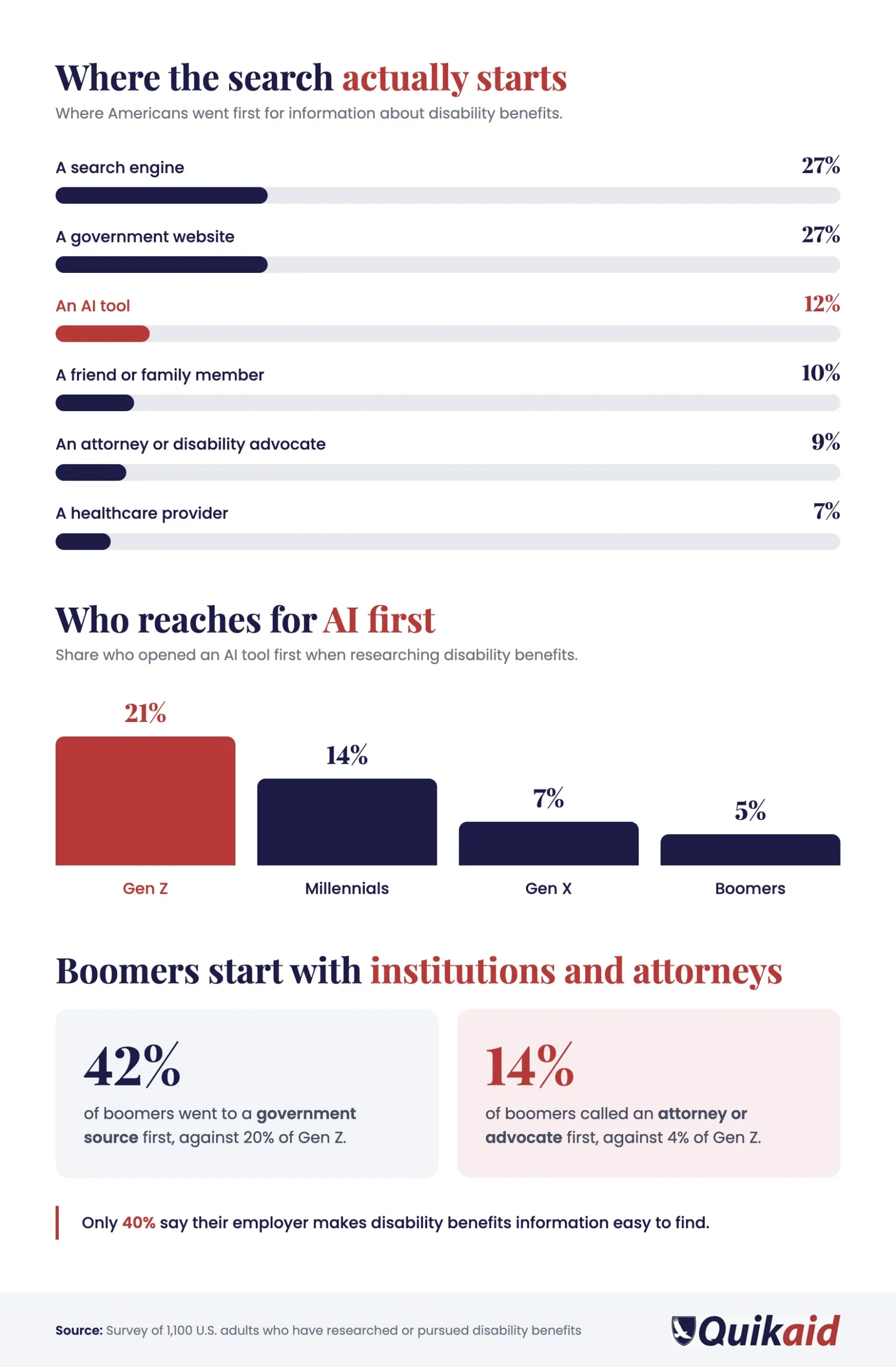
Over a quarter (27%) started their research via a search engine. The same overall share (27%) went straight to a government website. Another 12% used an AI tool for initial research, more than the 10% who turned to a friend or family member and the 9% who called an attorney or disability advocate. Only 7% went to a healthcare provider first, which is less surprising than it may seem. A treating physician supplies the medical records required to make a claim, but few doctors can explain how Social Security weighs them.
Baby boomers tended to go straight to a government source when researching disability benefits, at 42% against 32% of Gen X, 21% of millennials, and 20% of Gen Z. They’re also three times more likely than Gen Zers to call an attorney or disability advocate, at 14% to Gen Z’s 4%. But while Boomers are more trusting of establishments and experts, younger generations prefer more modern sources of information. A third (34%) of millennials turned to a search engine first. One in five Gen Zers (21%) opened an AI tool first, compared with 14% of millennials, 7% of Gen X, and 5% of Boomers. Each generation tends to turn to the tools they already trusted.
Even though their company may have answers, few workers turn to HR. Four in ten (40%) said their employer makes disability benefits information easy to find, and slightly more (42%) said their employer gives them enough information to understand those benefits in the first place. Fewer still (37%) said colleagues at work actively encourage the conversation. Many companies don’t prioritize employee education around their benefits, and that’s why people are turning to search engines and chatbots instead of their colleagues.
For most people, that research leads to immediate action. A majority (58%) made a meaningful first step within two weeks of beginning their research. But 14% still haven't taken one at all, and another 7% took more than three months to begin. Boomers stalled the most: 23% of the generation still hadn’t taken any meaningful action, over twice the amount of Gen Z that said the same (10%). Millennials, in contrast, acted fastest – 62% made a move within two weeks, including 11% who acted the same day they conducted their research. Younger generations are more decisive, since even a short period of disability can impact their long-term career. Boomers, who are close to or already within retirement, have more of a cushion to fall back on.
Too Much Information, Too Little Certainty
Finding information is one thing, but determining whether it can be trusted is another. The abundance of information online makes it so that some researchers become overwhelmed before they even begin an application. Here’s how people felt about their research and their ability to act on what they found.
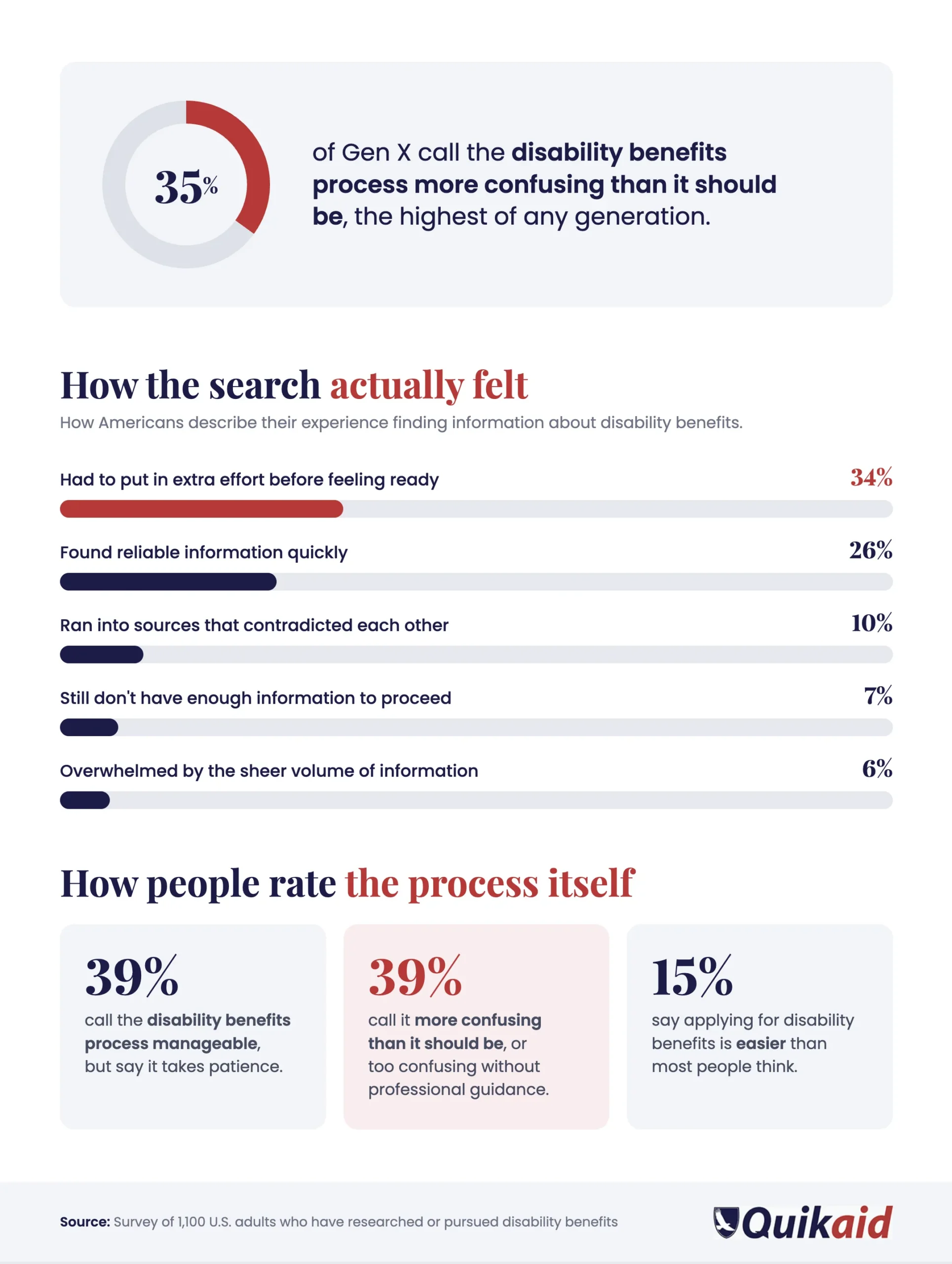
Only a quarter of those surveyed (26%) found reliable information quickly and felt confident right away. Everyone else worked for it, or is still working for it. Over a third (34%) had to put in extra effort before they felt ready to move forward. Another 10% ran into sources that flatly contradicted each other, and 6% were overwhelmed by the sheer volume of information available. Another 7% still don't feel they have enough information to proceed, offering a possible explanation for those who have done their research but taken no steps from there.
Boomers found information the fastest, with 30% saying they were immediately confident in their research, while only 23% of millennials said the same. But many boomers never got started: 12% said they still don't know where to begin, nearly double the share of Gen Zers who agreed (6%). Older Americans are split at both ends. The ones who found what they needed found it fast, but the ones who didn't stayed lost.
People described applying for disability benefits in much the same terms. Over a third (39%) called the process manageable but said it takes patience, reflecting the fact that the process generally takes six to eight months. Another 39% described the process as more confusing than it should be, or as too confusing to navigate without professional guidance. Only 15% said it's easier than most people think.
Gen X was the most worn down: 35% called the process more confusing than it should be, compared with just 21% of Gen Z. Boomers went even further, with 17% saying nobody should attempt it without professional help — more than double the 8% of millennials who agreed.
Women felt all of this more sharply. They were more than twice as likely as men to say they still don't know where to begin, at 9% to their 4%. They were more likely to call the process more confusing than it should be (32% vs. 24%), and nearly twice as many said they couldn't navigate it without professional help (15% vs. 8%). Men, for their part, were more likely to call the process easier than expected, at 18% to women’s 12%. Women arrive at the starting line with less confidence than men, and the people least sure of their footing are the same people most likely to put off their application.
The Moments People Nearly Walk Away
Applying for disability can be a long and confusing process. Your work history, state, and past applications can all influence the current process, and none of that is made clear upfront. When navigating the process on their own, many applicants almost quit, and here’s why.
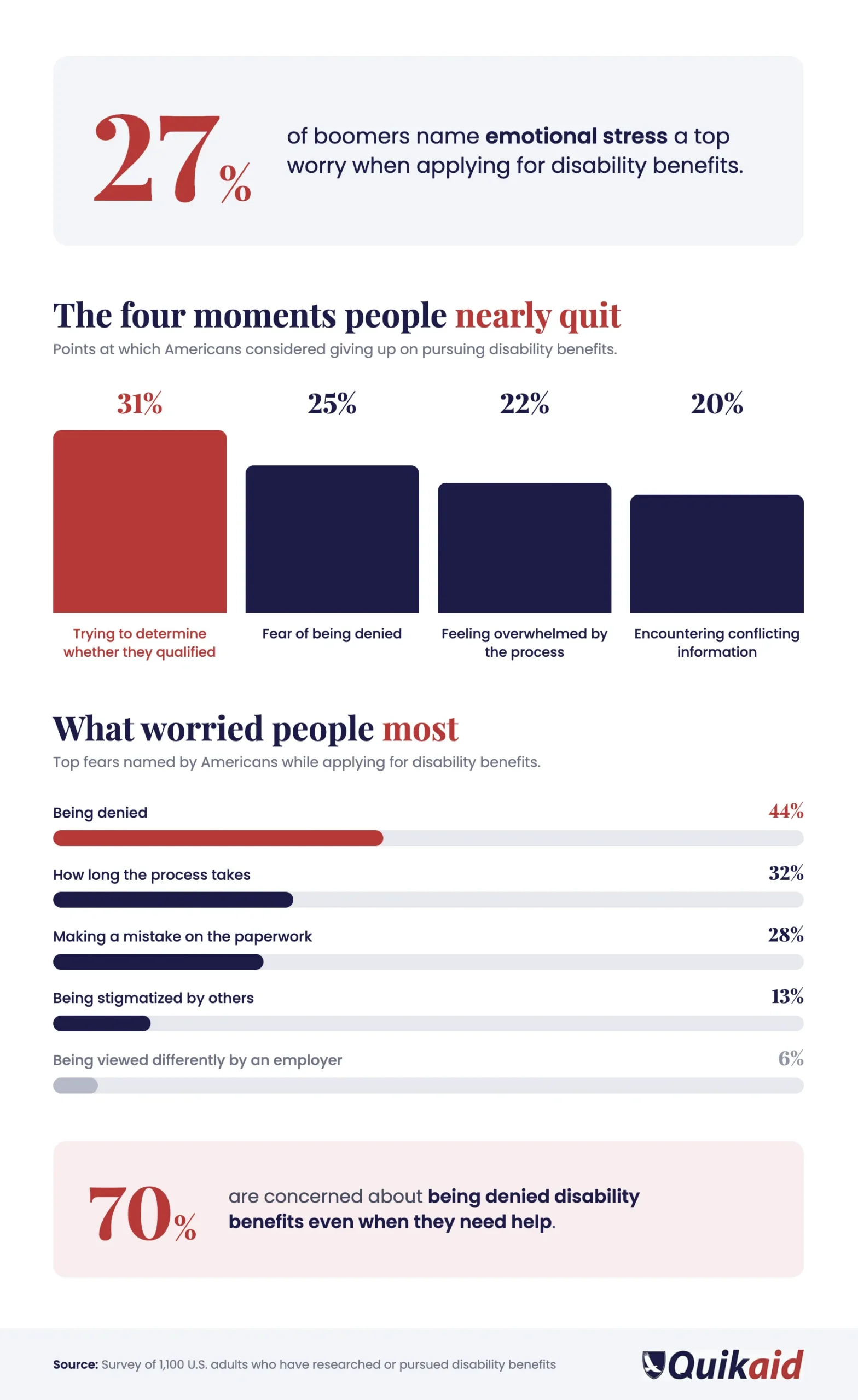
Respondents pointed to four moments that nearly drove them out of the process:
- Trying to determine whether they qualified (31%);
- Fear of being denied (25%);
- Feeling overwhelmed by the process (22%);
- Encountering conflicting information (20%).
Younger participants came closest to walking away. Only 12% of Gen Z and 15% of millennials said they never considered giving up, compared with 29% of Gen X and 44% of boomers. Fear of denial drove 30% of millennials to step back from the process, compared to 16% of boomers. Even if they didn’t step back from the process, people were worried about what would happen after they submitted. The top fears while applying for disability included:
- Being denied (44%);
- Finding out they don't qualify (39%);
- How long the process takes (32%);
- Making a mistake on the paperwork (28%);
- The emotional stress of the process (18%);
- Being stigmatized by others (13%);
- Being viewed differently by an employer (6%).
Older participants felt the emotional weight most: 27% of boomers and 22% of Gen X named emotional stress as a top worry, roughly double the 13% recorded among both Gen Z and millennials. This stress wasn’t unfounded: Social Security denied 68% of disabled-worker claims filed between 2014 and 2023, potentially including people who needed the services. In response, over two-thirds (70%) of respondents were concerned about being denied even when they need help. A long, confusing application process and a low approval rate are coming between workers and the help they need.
Where AI Helps, and Where It Doesn't
The conversational nature of an AI chatbot can make navigating disability feel less intimidating, and Americans are adopting it into their research processes accordingly. Despite the popularity of these tools, not everyone trusts them as a source of accurate information. While AI tools can help explain state-level laws or define SSDI in plain language, many look elsewhere for real help.
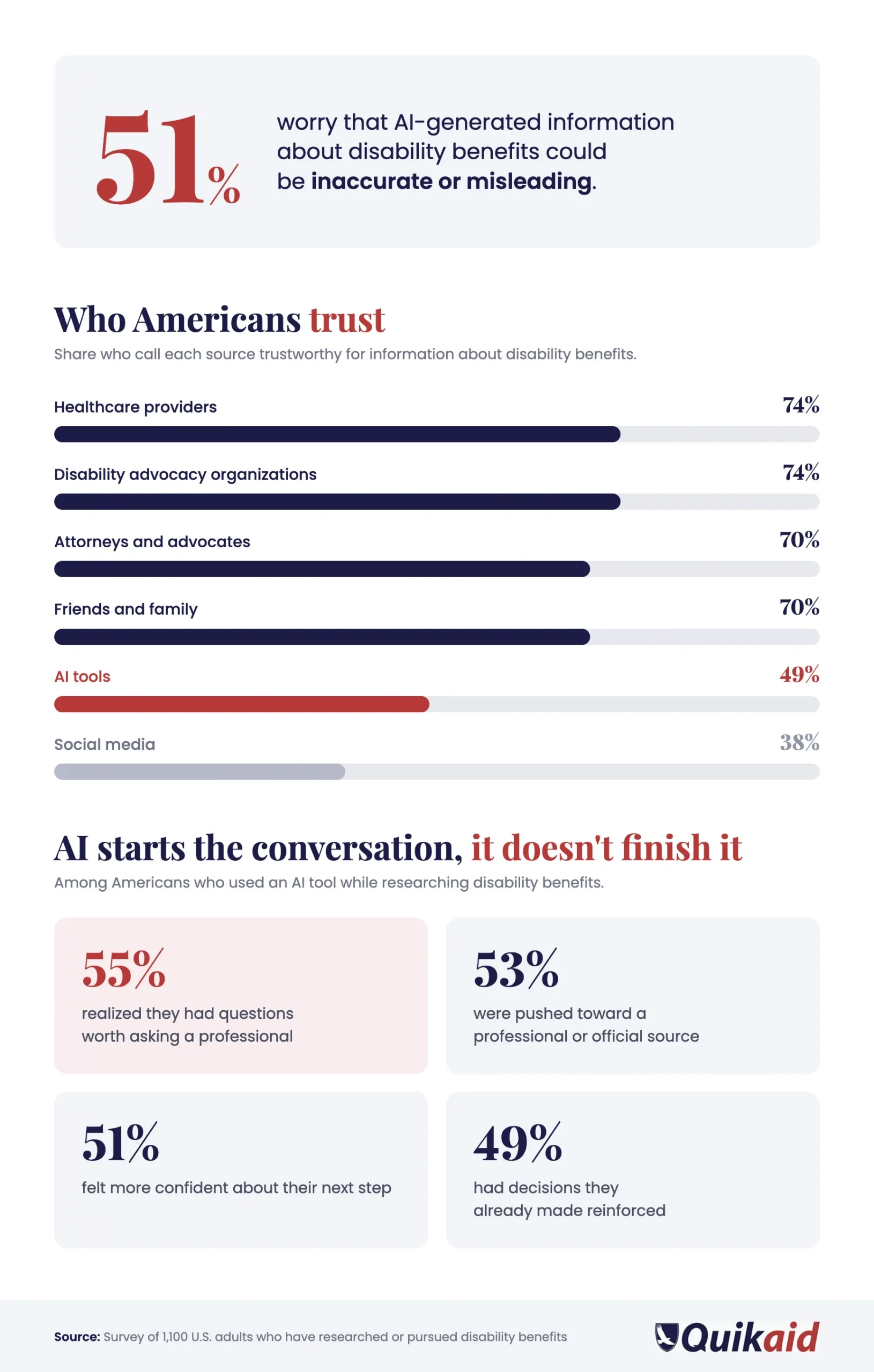
Respondents rated healthcare providers and disability advocacy organizations as most trustworthy, both at 74%, with attorneys and advocates close behind at 70%. The same share (70%) trusted their friends and family. Less than half of respondents (49%) called AI tools trustworthy, making AI the second least-popular option. It was only followed by social media, called trustworthy by only 38% of our survey participants. More people (51%) worried AI-generated information about disability benefits could be inaccurate or misleading, a reasonable fear when LLMs are known to “hallucinate” information.
Among people who used AI, the majority ended up being directed toward a real-world expert. Over half (53%) said an AI tool pushed them toward a professional or an official source, and 55% said it made them realize they had questions worth asking a professional. Another 51% said it left them more confident about their next step, and 49% said it reinforced the decisions they had already made about exploring or applying. People used AI to work out what to ask, then took the question to an expert.
Millennials trusted AI the most at 57%, with Gen Z just behind at 56%. That figure drops to 42% among Gen X and 32% among boomers. Boomers trusted attorneys and advocates more than any other generation did, at 76%, more than double the amount of them who trust AI. Gen X presents the odd case: only 7% went to an AI tool first, yet 42% said they trusted it. This could mean that Gen X didn't find the answers they were looking for in traditional search but then navigated to an AI tool for deeper insights.
AI appealed to far more men than women. Men trusted AI tools at 58% against 40% of women, and more men named AI tools as the single most trustworthy source of information (15% vs. 9%). Women were more likely to trust a professional disability advocate or attorney, at 33% to men’s 26%. Men may prefer the sycophantic way AI tools tend to present information, while women are more willing to go straight to the experts.
Whether someone reached for a chatbot or called an attorney, they were looking for the same thing: answers. AI can start that conversation, but many are rapidly learning that it can’t finish it.
Why So Many Skip Professional Help
A disability claim starts as a solo project for most people. The application is free, and the process is public, so many work through the beginning stages alone. Even though an attorney or disability advocate can guide people through a new process and prevent them from making expensive mistakes, very few turn to one. Here’s why:
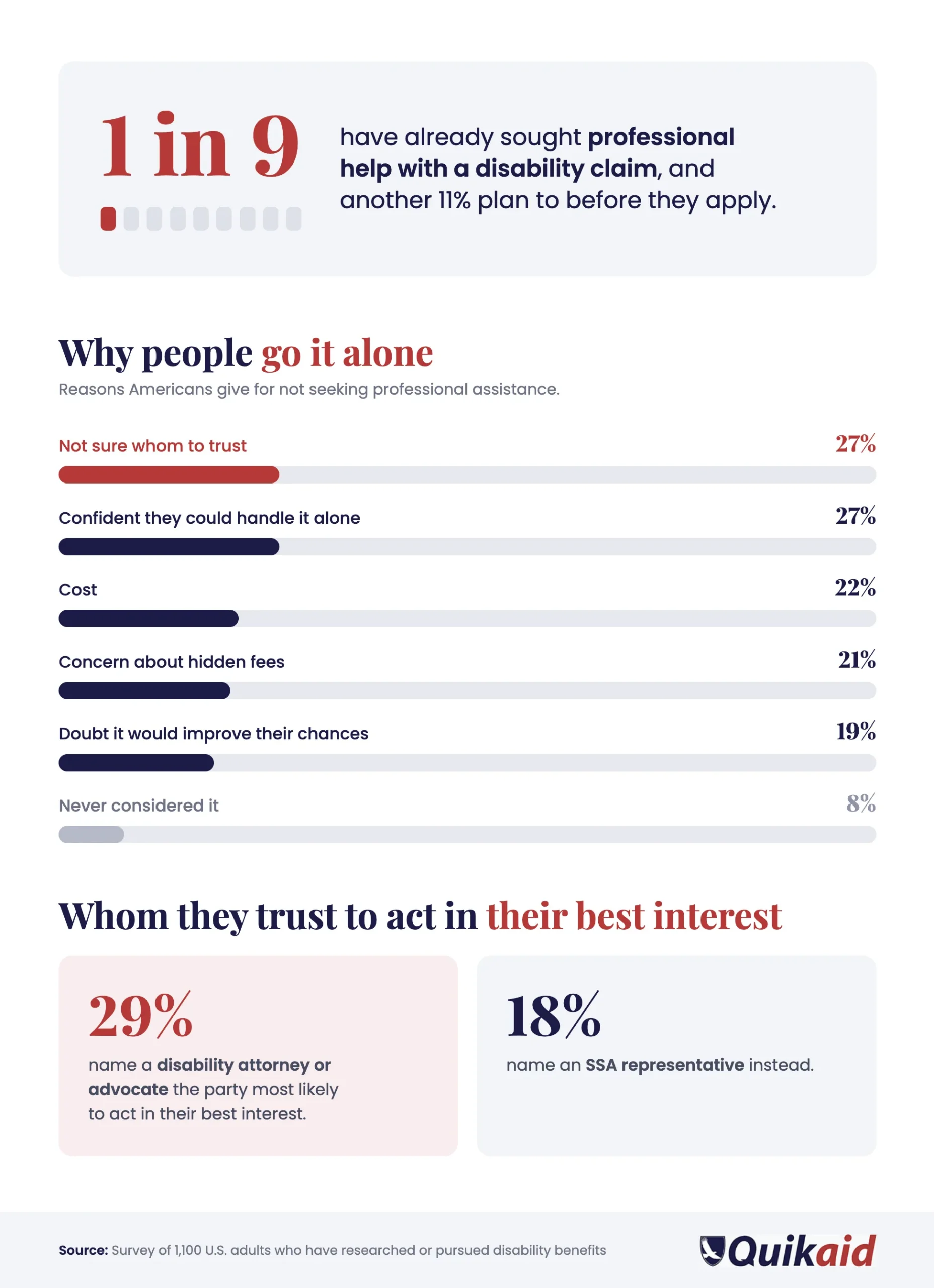
Respondents named these as the reasons they haven't sought professional help:
- Uncertainty about whom to trust (27%);
- Confidence in handling it alone (27%);
- Cost (22%);
- Concern about hidden fees (21%);
- Doubt it would improve their chances (19%);
- Never considered it (8%).
Those hesitations show up in how few people actually reached out. Just 11% had already sought professional assistance, and an identical 11% planned to do so before applying. When asked who they trusted most to act in their best interest, 29% of respondents chose a disability attorney or advocate, ahead of an SSA representative at 18%. But even if they know an attorney or advocate would be trustworthy, the practical hurdles prevent many people from being able to hire professional help. For others, the process seems easy enough to handle alone.
Younger generations were more confident in their ability to navigate the process on their own. A third of Gen Z (33%) thought they could manage the process themselves, compared to 21% of boomers. Another 29% of Gen Z said they didn't know professional help existed at all, more than double the 11% of boomers who said the same. Boomers put more faith in the agency itself: 29% named an SSA representative as their most trusted guide, compared with 13% of Gen Z. Older Americans trust the institution to look out for them. At the same time, younger generations feel more confident if they do it themselves.
Men and women looked in different directions for guidance. Women named a disability attorney or advocate as their most trusted source more often than men did, at 33% to 26%, while men more often named an AI tool, at 15% to 9%. Both groups were solving the same problem: finding a source willing to answer questions they weren't sure how to ask. But only one of those sources has the expertise applicants actually need.
What the Check Actually Pays For
Finishing the application and getting approved can feel like the finish line, but many find that the check they receive barely covers the mortgage. Those who have gone through the process need to make a plan for filling in the gap between their bills and what SSDI actually grants. Here’s how they make ends meet:
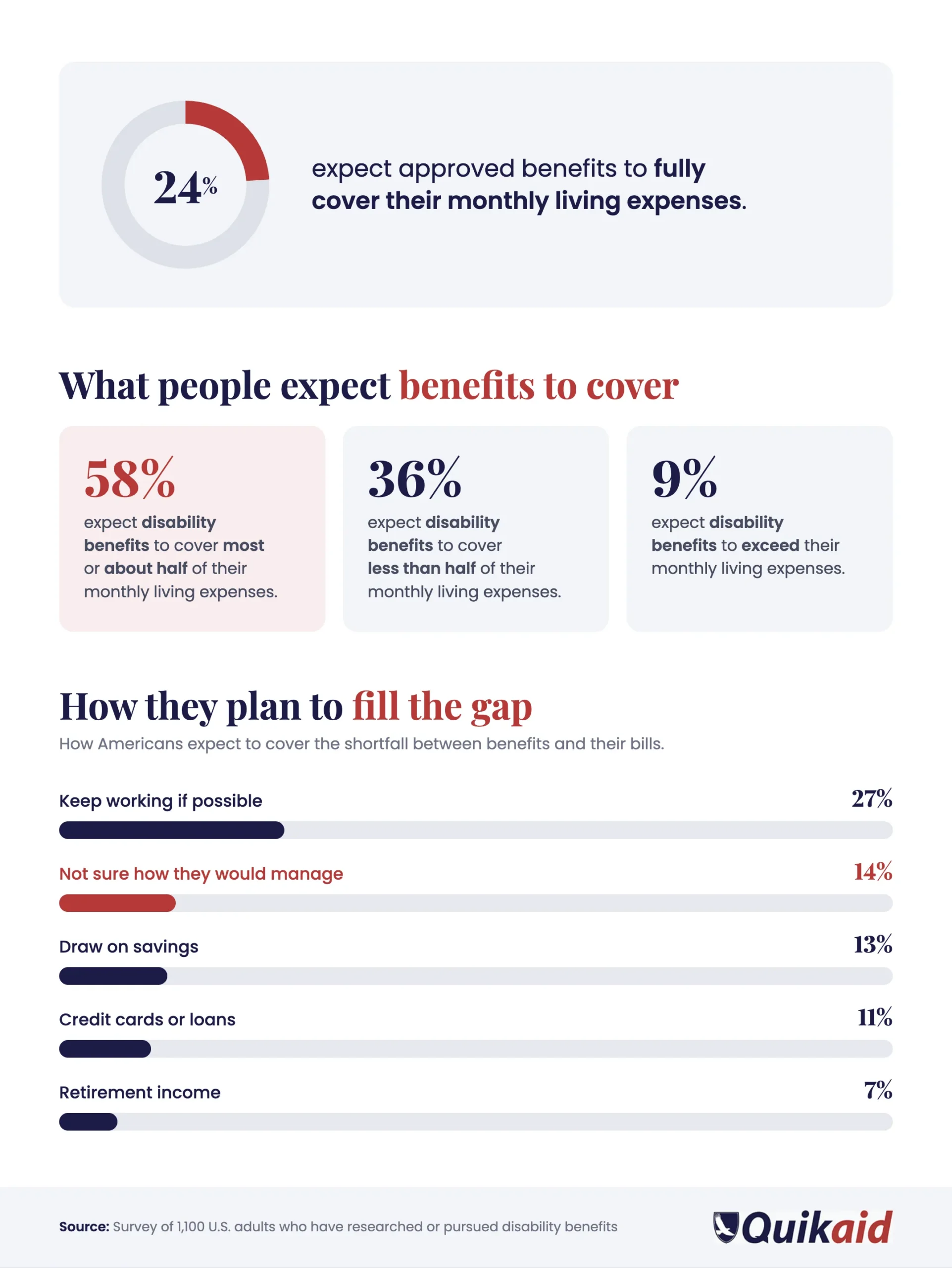
Only 24% expected approved benefits to cover their monthly living expenses fully. Even more (58%) expected benefits to reach most or about half of what they needed, and more than 1 in 3 (36%) expected it to cover less than half. Just 9% expected to have money left over. These are largely realistic expectations – SSDI is designed to replace a portion of earnings, not match their old salary entirely.
How people planned to cover that gap varied more than the gap itself — more than a quarter (27%) planned to keep working, which could be risky. Earning above Social Security's substantial gainful activity threshold can disqualify a claim outright, so many would only be able to work part-time, if at all. Another 13% planned to utilize savings, 11% named credit cards or loans, and 7% would lean on their retirement income. Another 14% had no plan whatsoever, admitting they weren't sure how they'd manage a shortfall. A disability representative won’t build a household budget, but they can help applicants understand how work activity could affect a claim and what benefits they may realistically receive, which gives any plan for covering the gap a firmer starting point.
Younger applicants expected more from the program. Nearly a third (31%) of both Gen Z and millennials expected benefits to cover everything, against 17% of Gen X and 14% of baby boomers. Boomers expected the widest gap, with 44% anticipating a shortfall of half or more, compared with 32% of both Gen Z and millennials. Boomers also had the easiest backup plan, with 21% planning to draw on retirement income, against 5% of Gen X, 6% of Gen Z, and 2% of millennials. While older Americans have years of built-up savings and retirement to fall back on, younger Americans have to hope for substantial coverage. Without the right guidance, a member of Gen Z who needs disability to make ends meet may miss out on what they need.
The Claims That Never Get Filed
Social Security disability insurance is something workers pay for. It comes out of every paycheck across a career, and people deserve to draw on those benefits when they need them. When someone can't figure out whether they qualify and stops there, they give up on coverage they’ve already financed.
However, not knowing what a claim requires carries a price that isn't visible from outside the system. The timing of an application alone doesn’t decide whether it’s approved, but when someone learns what Social Security needs to see often does. Claims largely rise or fall on medical evidence, such as consistent treatment and records showing how a condition limits a person’s ability to work, and people who learn that late may be missing the documentation their claim depends on. Timing matters in one more way: Social Security asks that a person have worked recently enough, not only long enough, so putting off an application for too long after leaving work can change what someone is eligible to receive. That falls hardest on the people who were least certain where to turn in the first place. Not everyone who gave up would have been approved, but the agency exists to make that determination. A person shouldn't have to guess at it alone.
People aren’t helpless, though. Instead, they’re finding tools to help guide them along. Younger applicants use an AI tool rather than a government homepage, and that shift will accelerate as they reach the years when disability claims become more common. The growth of these tools depends on whether the answer they get about eligibility is correct. That's the question people most often quit over, and getting it right early is what separates an application that happens from one that never does.
This article has been reviewed and approved by Quikaid staff, many of whom previously worked at the Social Security Administration in leadership positions within the disability adjudication process.
Methodology
Quikaid surveyed 1,100 U.S. adults via Pollfish who had researched, considered, or taken steps toward applying for disability benefits within the past three years. The screener excluded respondents with no prior experience with the process. The survey examined first-touch information sources, timeframes to action, confidence and confusion in the research process, moments of hesitation or near-abandonment, trust across eight information sources including AI tools, professional-help-seeking behavior, financial expectations for benefit coverage, and employer support. Results were stratified and analyzed across demographic segments including generation (Gen Z, millennials, Gen X, Baby Boomers) and gender. Percentages reflect self-reported data and may sum to more than 100% when multiple selections were allowed.
About Quikaid
Quikaid has represented Social Security disability claimants since 1993, handling SSDI and SSI cases from the initial application through hearings before an administrative law judge. Based in St. Petersburg, Florida, the company works with clients across the country and takes disability claims exclusively. Quikaid collects no fee unless a claim is approved — which answers, directly, the cost question that keeps many applicants from seeking help at all.
Fair Use Statement
The findings on this page are free to share for noncommercial purposes. If you use them, please credit Quikaid and include a link back to this page so readers can review the full study and methodology.
Share via:
HIRE AMERICA'S DISABILITY EXPERTS NOW
If you need disability benefits, hire Quikaid now. You will not regret it. We will do everything possible to get your claim approved.
Sign our contract now online, complete our Free Case Evaluation, or call (800) 941-1321 so we can start the process of getting you approved for benefits! You have nothing to lose, and everything to gain.
The time to get started is NOW!