




How to Apply for Disability Benefits: A Step-by-Step Guide to SSDI and SSI
Apply For Disability
You can apply for Social Security disability benefits online at SSA.gov, by phone at 1-800-772-1213, or at a local Social Security office. Before you apply, it helps to know which program fits you: Social Security Disability Insurance (SSDI), Supplemental Security Income (SSI), or both. In July 2026, the Social Security Administration (SSA) took about six months on average to make a first decision.
This guide explains how to apply for disability benefits from start to finish. Quikaid is a Social Security disability representation firm, and we've helped over 250,000 people through this process since 1993. Many of the people we talk with are in their 50s or early 60s and applying for the first time after decades of work. If that's you, you'll find a section written with you in mind.
Key Takeaways (Published: September 29, 2026)
- You can apply online, by phone, or in person. Contacting the Social Security Administration (SSA) to say you plan to apply can set a protective filing date, which may protect back pay.
- SSA weighs several factors together: whether you're working full time, your medical evidence, your age, and your past work.
- SSDI depends on your work history. Most people need 40 work credits, 20 of them earned in the last 10 years. In 2026, one credit equals $1,890 in earnings.
- SSI depends on limited income and assets. In 2026, the asset limit is $2,000 for an individual and $3,000 for a couple.
- You don't need your medical records in hand to apply. You need your doctors' names, your treatment dates, your medications, and your jobs from the last five years. SSA requests the records.
- In July 2026, SSA took 186 days on average to make a first decision, down from 220 days a year earlier.
- If you're denied, you have 60 days to appeal, plus five days for mail.
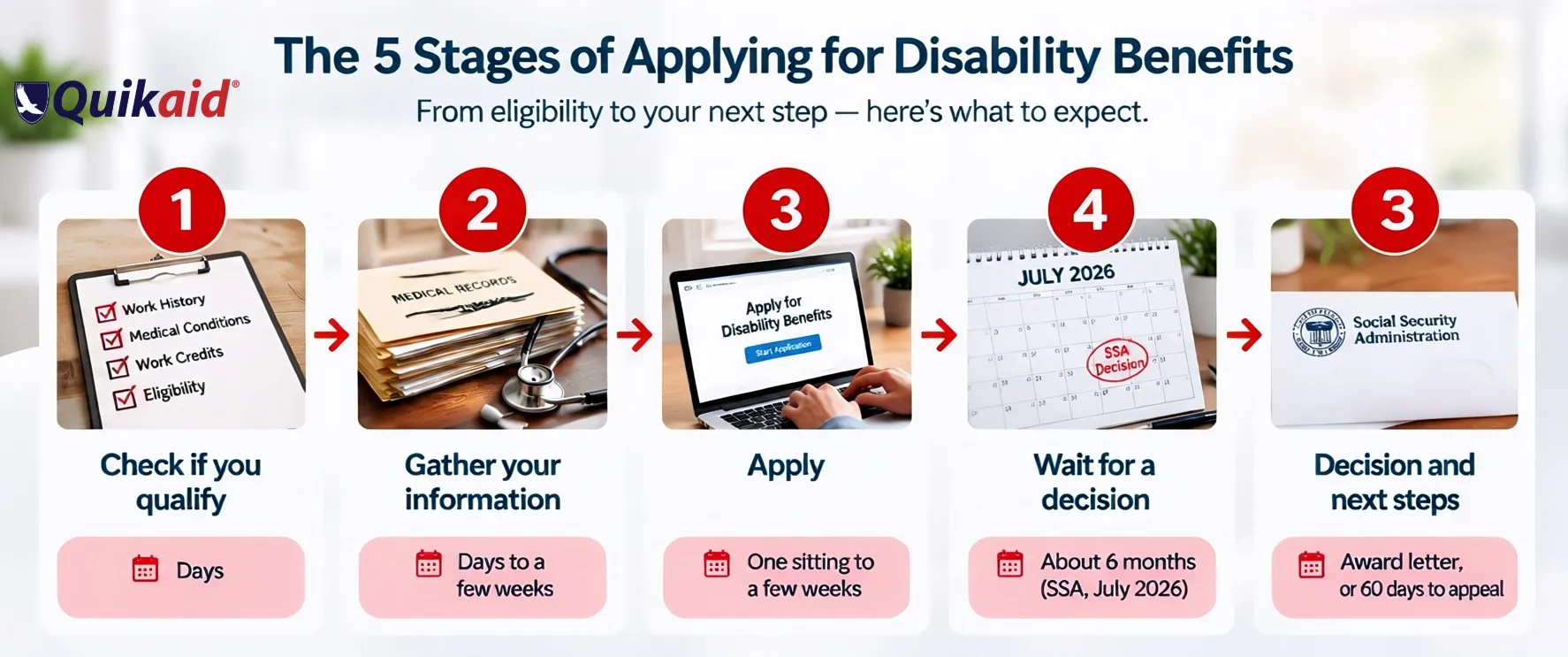
The process has five stages: checking whether you qualify, gathering your information, applying, waiting for a decision, and what comes next. This guide covers Social Security programs only, not short-term disability, private long-term disability insurance, VA disability ratings, or workers' compensation.
Stage 1. Before You Apply: Do You Qualify for Disability Benefits?
The Social Security Administration (SSA) looks at several things together to decide if you qualify for disability benefits: whether you're working full time, how your medical condition limits you, your age, and your past work. Your condition must be expected to last at least 12 months or result in death. SSDI also depends on your work history, while SSI depends on limited income and assets.
This first stage is where many people get stuck. In a February 2026 Quikaid survey of 1,100 U.S. adults conducted via Pollfish, 31% said figuring out whether they qualified almost made them give up.
Which Program Fits You: SSDI, SSI, or Both?
SSDI is insurance you paid for through Social Security taxes on your paychecks. SSI is a needs-based program for people with limited income and assets, and it doesn't require a work history. Both use the same medical definition of disability. The table below shows how they differ.
A simple way to think about it: if you've worked most of your adult life and paid Social Security taxes, SSDI is usually the program to start with. If you haven't worked much, or you haven't worked in many years, SSI may be the better fit. Some people qualify for both. You don't have to figure this out perfectly before you apply, because SSA checks your eligibility for each program.
| Feature | SSDI | SSI |
|---|---|---|
| Who it's for | Workers who paid Social Security taxes | People with limited income and assets |
| Work history needed | Yes, enough work credits | No |
| Asset limit (2026) | None | $2,000 individual, $3,000 couple |
| Monthly amount (2026) | Based on your lifetime earnings | Up to $994 individual, $1,491 couple (federal rate) |
| Waiting period | Five full months | None |
| Health coverage | Medicare after 24 months of entitlement | Medicaid in most states |
| Back pay | Up to 12 months before your application date | From the month after you apply |
For a deeper look at the rules for each program, you can compare SSDI and SSI in detail.
Can You Get SSDI and SSI at the Same Time?
Yes. If your SSDI payment is low and you also meet SSI's income and asset limits, you may receive both. People in this situation are sometimes called concurrent beneficiaries. One application can cover both programs.
Have You Worked Long Enough to Qualify for SSDI?
SSDI uses work credits to measure your work history. Generally, you need 40 credits, and 20 of them must be earned in the 10 years ending with the year your disability began. Younger workers can qualify with fewer. In 2026, you earn one credit for every $1,890 in wages or self-employment income, up to four credits a year.
Your credits don't last forever. The last date your work credits still give you coverage is called your Date Last Insured (DLI). If you stopped working several years ago, your DLI matters a lot. Learn more about how work credits affect SSDI eligibility.
Are You Still Working Full Time?
If you're still working full time, SSA usually won't find you disabled, no matter how serious your condition is. SSA's term for this is substantial gainful activity (SGA). In 2026, earning more than $1,690 a month ($2,830 if you're blind) generally counts as SGA. Part-time work under that amount doesn't rule you out on its own.
How SSA Evaluates Disability
The Social Security Administration evaluates disability claims using a five-step process, answering these basic questions:
- Are you working full time?
- Is your condition severe?
- Does your condition meet a listing?
- Can you do your past work?
- Can you do any other work?
In the majority of disability claims, the last question is the one that matters most, and this is where a well-built case can make the difference between an approval and denial.
The "listing" in step three refers to SSA's Blue Book listings index, the official list of medical conditions and the criteria for each. The full process is set out in federal rules at 20 CFR 404.1520.
See How Much You May Qualify For With Quikaid's Free Disability Calculator Tool:
Why Age Matters If You're 50 or Older
At step five, SSA doesn't only ask whether some job exists that you could do. It also looks at your age, your education, and your past work. These are called the medical-vocational rules, or "grid rules." Under these rules, SSA gives more weight to age as you get older:
- Ages 50 to 54 are "closely approaching advanced age."
- Ages 55 and older are "advanced age."
These categories are set out in 20 CFR 404.1563. They matter most when your condition keeps you from doing your past work. SSA also looks at your residual functional capacity (RFC), which is the most you can still do despite your limits. When SSA looks back at your past work, it reviews the last five years.
If you're 62 or close to it, you may also be weighing early retirement against SSDI. The two work very differently, and the choice can affect your monthly amount for years. Our guide to SSDI and early retirement walks through that decision.
Are the Rules the Same in Every State?
The medical and work rules are federal, so they're the same everywhere. What changes is the pace. Each state runs its own Disability Determination Services (DDS) office, and some move faster than others. Some states also add a supplement to the federal SSI payment. See disability qualifications by state for details.
Stage 2. Gather the Information You'll Need
You don't need to collect your medical records before you apply. The Social Security Administration (SSA) requests them from your doctors. What you do need is the information SSA uses to find them: your doctors and clinics, your treatment dates, your medications, your test history, and your jobs from the last five years.
Your Application Checklist
Having these details ready before you start makes the application go faster.
About you:
- Your Social Security number
- Your birth certificate or other proof of age
- Bank account information for direct deposit
- Names and dates of birth of your spouse and minor children, if any
About your health and work:
- Names, addresses, and phone numbers of every doctor, clinic, and hospital that treated you
- Dates of your visits and any hospital stays
- Your current medications and who prescribed them
- Tests you've had, such as X-rays, MRIs, or blood work, and where they were done
- Your jobs from the last five years, with dates and job duties
- Your most recent W-2, or your tax return if you're self-employed
You'll also see a few SSA forms by number. The application itself is Form SSA-16. The Adult Disability Report (SSA-3368) asks about your conditions, treatment, and work. Form SSA-827 gives SSA permission to request your medical records. For the full list, see our disability application documents checklist.
Medical Evidence That Carries Weight
A diagnosis alone isn't enough. SSA looks for medical evidence that shows how your condition limits what you can do, and it looks for that evidence over time. Three things help most:
- Consistent treatment. Continuously seek medical treatment. Regular visits create a record of your condition.
- Objective findings. Imaging, lab results, and test scores back up what you report.
- Notes on daily limits. Records that describe how your condition affects walking, sitting, lifting, focusing, or daily tasks.
If you can't afford regular care, look for a county health department, a sliding-scale clinic, or a charitable program in your area. Learn more about the medical evidence that supports a disability claim.
Tips for Filling Out the Adult Disability Report
The Adult Disability Report (SSA-3368) is where you describe your conditions, your treatment, and how your health affects your work. It carries a lot of weight, so take your time with it.
- List every condition. Include physical and mental health conditions, even ones you think are minor. Conditions can add up.
- Describe your worst days, not just your good ones. If you can sit for 10 minutes before you need to stand, say "10 minutes," not "a while."
- Be consistent. What you write should line up with what your doctors have recorded. Differences get noticed.
- Don't leave out past work. Describe the duties of each job from the last five years, including how much you lifted and how long you stood or sat.
- Keep a copy. You'll want it if SSA asks follow-up questions or if you need to appeal.
Check Your Condition Against the Blue Book
SSA's Listing of Impairments, often called the Blue Book, lists conditions and the medical findings needed to meet each one. Meeting a listing is one path to approval, but it isn't the only one. Many people who don't meet a listing are approved at step five, based on what they can and can't do.
Stage 3. File Your Application for SSDI or SSI
You can apply for SSDI online at SSA.gov at any time if you're 18 or older. Many adults can apply for SSI online at the same time, as long as they're also applying for SSDI and meet a few other conditions. Everyone else can call the Social Security Administration (SSA) to start an SSI application and finish it at an appointment.
Online, by Phone, or in Person: Which Is Right for You?
Each way to apply has its own strengths. The table below shows which fits you best.
| Method | Best for | What to expect | SSI note |
|---|---|---|---|
| Online at SSA.gov | Adults who can work through forms at their own pace | You can save and return; you get a confirmation number | Some adults can apply for SSI online at the same time |
| Phone: 1-800-772-1213 (TTY 1-800-325-0778) | People who want to talk it through | Open 7 a.m. to 7 p.m., Monday through Friday; wait times vary | You can start an SSI application by phone |
| In person at a local office | People who need help with forms | An appointment is recommended | Often where an SSI application is finished |
To apply for SSDI online, you must be 18 or older, not already receiving benefits on your own Social Security record, and not denied disability benefits in the last 60 days. To use the simplified online SSI application, you must be between 18 and 64 years and 10 months old, applying for SSDI too, never married, and never have applied for SSI for yourself or a child.
However you start, the date you first contact SSA to say you plan to apply can become your protective filing date. That date can hold your place for back pay while you finish the application, so don't wait until every detail is perfect to make contact.
Who Can Help You Apply?
You can apply on your own, with help from a family member, or with a disability representative. SSA staff can take your application and answer general questions, but they don't represent you.
A disability representative works for you. At Quikaid, we gather your information and submit your application. From there, we make sure it's properly processed and sent for a medical decision, follow up on anything SSA asks for, and stay with you until a decision is made. If you're denied, we handle the appeal.
Not sure if your medical condition qualifies?
Get a free disability case review. Quikaid is America's Disability Experts® — no fee unless you win.
Get a Free Case Evaluation Sign Our Contract OnlineMost people go it alone. In the same February 2026 survey, only 11% of people researching disability benefits had gotten professional help. That matters, because you're 3x more likely to be approved for disability benefits with an expert representative in your corner.
Disability Representative or Disability Lawyer?
Quikaid is a disability representation firm, not a law firm. Some of our team members are attorneys, and others are licensed by SSA to represent people applying for disability benefits. Disability representation is all we do. To see how the two roles compare, read disability representative vs. disability lawyer.
Do You Pay a Representative If You Don't Win?
Cost is one of the biggest reasons people hesitate to get help. Payment for disability representation doesn't work like it does for other legal services.
No upfront cost. Pay only if you win. Fees are capped by federal law.
We don't require a retainer. There's no hourly billing, and we can provide you with guidance now.
Applying for a Child
Children with disabilities can qualify for SSI based on their own condition and their family's income and assets. A child can also get benefits on a parent's record if the parent receives SSDI. An SSI application for a child can't be completed fully online, so parents should call SSA to set up an appointment. Learn more about child disability benefits.
Veterans Applying for SSDI or SSI
A VA disability rating doesn't carry over to Social Security, because SSA uses its own definition of disability. But veterans with a 100% Permanent and Total (P&T) VA rating can get their application handled as a high priority. Say you're a "veteran rated 100% P&T" when you apply (in the Remarks section online) and provide your VA notification letter.
Stage 4. After You Apply: What the Disability Application Process Looks Like
The Social Security Administration (SSA) sends your application to your state's Disability Determination Services (DDS) office, which decides the medical part. In July 2026, a first decision took 186 days on average, down from 220 days a year earlier.
What the Field Office Checks First
Before your application goes to DDS, your local Social Security office reviews the non-medical rules. For SSDI, that means confirming your work credits and checking whether you're working full time. For SSI, it means reviewing your income, your assets, and your living situation. If something is missing, the field office will contact you. Once these rules are met, your application moves to DDS for the medical review.
How Long the First Decision Takes
About six months is the national average, but individual applications move faster or slower. Things that can slow a decision include doctors who are slow to send records, missing contact information, and the need for an extra exam. For a stage-by-stage breakdown, see how long does SSDI take to get approved.
What Happens at DDS
A DDS examiner, working with a medical consultant, reviews your application. Along the way, DDS may:
- Request records from every doctor and clinic you listed
- Send you a function report asking how your condition affects daily life
- Schedule a consultative exam with an outside doctor, at no cost to you
Do not skip a consultative exam. If you can't make the appointment, call to reschedule right away.
Keep your contact information current, too. Make sure the Social Security Administration (SSA) and your representative can reach you. If they can't, your claim could be denied.
What to Do While You Wait
Waiting is the hardest part for many people, but there are useful things you can do in the meantime:
- Keep going to your appointments. Treatment that continues while you wait adds to your medical record.
- Open every letter from SSA right away. Many requests come with a deadline.
- Report changes. Tell SSA if you see a new doctor, start a new medication, move, or go back to work.
- Keep notes. A simple journal of symptoms, bad days, and missed activities can help you answer questions later.
How to Check Your Application Status
Your my Social Security account shows the status of your application. SSA added a Claim Status Tracker in July 2026 that follows cases at the hearing and appeal levels. You can also call 1-800-772-1213.
Ways to Speed Up Your Application
Some applications move faster than the average. SSA has three main ways to speed things up:
- Compassionate Allowances. More than 300 serious conditions, a list SSA regularly expands, can qualify for a faster decision.
- Terminal Illness (TERI) cases. Applications involving a terminal illness are flagged for faster handling.
- Dire need. If you lack food, medicine, or shelter, or face losing your home, SSA may move your application up.
The SSDI Five-Month Waiting Period
SSDI has a waiting period. SSA generally pays your first SSDI benefit in the sixth full month after the date it finds your disability began. SSI has no waiting period. The waiting period also affects how much back pay you receive, which Stage 5 explains.
Stage 5. Your Decision and What Comes Next
If you're approved, the Social Security Administration (SSA) mails an award letter showing your monthly amount, your start date, and any back pay. If you're denied, you have 60 days to appeal, plus five days for mail.
If You're Approved: When Payments and Back Pay Arrive
Your award letter explains your monthly payment and the date your benefits begin. It also shows your past-due benefits, often called back pay. For SSDI, back pay can reach up to 12 months before your application date, after the five-month waiting period. For SSI, back pay starts with the month after you applied. Learn more about disability back pay.
Approval also brings health coverage. SSI recipients qualify for Medicaid in most states. SSDI recipients become eligible for Medicare after 24 months of entitlement to benefits. Once you're approved, your benefits continue as long as you remain disabled. SSA may review your case from time to time to confirm that your condition still keeps you from working.
If You're Denied: How to Appeal
Receiving a denial is unfortunately part of the process for most claimants. However, you have the right to appeal. This is one step where it can be extremely helpful to have an experienced representative in your corner.
There are four levels of appeal: a request for reconsideration, a disability hearing before an Administrative Law Judge (ALJ), review by the Appeals Council, and federal court. At reconsideration, a different DDS examiner takes a fresh look at your application, along with any new evidence. At a hearing, you can explain your situation in person to a judge, often with a representative at your side. Each level takes time.
| Stage | Average processing time (SSA, July 2026) |
|---|---|
| First decision | 186 days |
| Reconsideration | 214 days |
| Hearing | 275 days |
You have 60 days from the date you receive a denial notice to appeal, and SSA assumes you received it five days after the date on the letter. Treat that window seriously. Appealing on time keeps your original application date, which protects your back pay. SSA can accept a late appeal if you have a good reason, but it's much better not to rely on that.
The right next step depends on where you are in the process. After an early denial, appealing is usually the way to go. After a judge denies a case, a new application can sometimes be the faster path. That's a decision worth talking through with a representative who can look at your situation.
Explore Every Step: The Full Guide Map
Each stage of the application has its own detailed guide.
| Stage | Guides |
|---|---|
| 1. Qualify | SSDI and SSI qualifications checklist · SSDI vs. SSI · Work credits · SSDI and early retirement · Qualifications by state |
| 2. Gather | Documents checklist · Medical evidence · Blue Book listings |
| 3. Apply | Representative vs. lawyer · Child disability benefits |
| 4. Wait | How long SSDI takes · Compassionate Allowances · Dire need |
| 5. Next steps | Back pay · Reconsideration · Disability hearing · Appeals |
Get Help With Your Application
Knowing how to apply for disability benefits comes down to five stages. First, check whether you qualify under SSDI, SSI, or both. Next, gather the names, dates, and work details SSA needs. Then apply online, by phone, or in person. After that, wait for a decision, which averaged about six months in July 2026. Finally, if you're approved, watch for your award letter, and if you're denied, appeal within 60 days.
You don't have to do this alone. No cost, no obligation, and we only get paid by the Social Security Administration if you win. You have nothing to lose by hiring Quikaid to help you win your claim. Start your Free Case Evaluation today. It's free, there's no obligation, and it only takes about 60 seconds.
Hire America's Disability Experts®
Whether you're applying, appealing, or waiting on payment after approval, Quikaid will do everything possible to get you paid. Free case evaluations, and no fee unless you win.
Sign Our Contract Online Now Call (800) 941-1321Quikaid is not affiliated with the Social Security Administration (SSA) or any other government agency. SSA makes all decisions on disability applications.
Frequently Asked Questions (FAQs)
Can I apply for disability if I'm already taking early retirement at 62?
Yes. You can apply for SSDI before full retirement age, even if you already get early retirement. If the Social Security Administration (SSA) approves you, it can switch you to disability benefits, and the early retirement reduction may shrink or go away, depending on when your disability began. Learn more about how disability and retirement benefits interact.
How does earned income affect SSDI benefits while my application is pending?
You can work while your application is pending, but your earnings matter. In 2026, earning more than $1,690 a month ($2,830 if you're blind) usually means SSA won't find you disabled. Part-time work below that amount doesn't rule you out, but SSA will still look at what that work shows about your abilities.
Do I need a representative to apply for disability benefits?
No, a representative isn't required. But a representative can file your application, follow up on anything SSA asks for, and handle appeals if you're denied. With Quikaid, there's no upfront cost, and you pay only if you win. The amount a representative can charge is limited by federal law.
Can someone receive both SSI and SSDI benefits?
Yes. People with a low SSDI payment who also meet SSI's income and asset limits may receive both at the same time. One application can cover both programs, so you don't need to file twice. SSA will check your eligibility for each program as part of the same review.
What is a protective filing date, and why does it matter?
A protective filing date is the date you first contact SSA to say you plan to apply. It can hold your place while you finish your application, which may protect back pay you'd otherwise lose. That's why it's smart to contact SSA as soon as you decide to apply, even before every detail is ready.
Will Social Security send me to a doctor?
Possibly. If your medical records don't give Disability Determination Services (DDS) enough information, it may schedule a consultative exam with an outside doctor, at no cost to you. Go to the exam, be on time, and describe your limits honestly, including how you feel on your worst days.
Should I reapply or appeal if my disability application is denied?
It depends on the stage. After an early denial, appealing within 60 days keeps your original application date and protects your back pay. After a judge denies a case, a new application is often the faster path. Talk it through with a representative who knows your situation. See our guide to the disability appeal process.
This article has been reviewed and approved by Quikaid staff, many of whom previously worked at the Social Security Administration in leadership positions within the disability adjudication process.

All SSDI and SSI claims are subject to Social Security Administration review and approval. Past results do not guarantee future outcomes. Quikaid's fee is regulated by the SSA and only applies if your claim is approved. The free case evaluation is provided at no obligation.
Survey methodology: Quikaid surveyed 1,100 U.S. adults via Pollfish in February 2026. Respondents had researched, considered, or taken steps toward applying for disability benefits within the past three years; people with no prior experience with the process were screened out. Results were analyzed across demographic segments, including generation.
External Sources Cited:
| Claim | Source | Verified |
|---|---|---|
| 2026 SGA $1,690 / $2,830; SSI $994 / $1,491; $1,890 per credit; $2,000 / $3,000 resource limits | SSA 2026 COLA Fact Sheet | Sept 29, 2026 |
| 186 days initial (220 a year earlier); 214 reconsideration; 275 hearing | SSA performance data | Sept 29, 2026 (July 2026 data) |
| Online SSDI eligibility; phone 7 a.m. to 7 p.m. weekdays; TTY | SSA: Apply Online for Disability | Sept 29, 2026 |
| Simplified online SSI conditions; parents of minors call for an appointment | SSA blog, Dec 16, 2024 | Sept 29, 2026 |
| 40 credits / 20 in last 10 years; five-month waiting period | SSA: How to qualify for disability | Sept 29, 2026 |
| 100% P&T veterans treated as high priority; identify in Remarks; VA letter; no guarantee | SSA publication EN-05-10565 | Sept 29, 2026 |
| Claim Status Tracker | SSA press release, July 21, 2026 | Sept 29, 2026 |
| Five-step process; age categories | 20 CFR 404.1520, 20 CFR 404.1563 | Sept 29, 2026 |
| 3x more likely with a representative | GAO-18-37 (hearing-level data, FY2007 to 2015) | Sept 29, 2026 |
| 31% nearly quit; 11% got professional help | Quikaid survey, 1,100 U.S. adults, Pollfish, February 2026 | Sept 29, 2026 |
| Program overview (project-required) | ssa.gov/disability, NCOA, USA.gov | Sept 29, 2026 |
Share via:
HIRE AMERICA'S DISABILITY EXPERTS NOW
If you need disability benefits, hire Quikaid now. You will not regret it. We will do everything possible to get your claim approved.
Sign our contract now online, complete our Free Case Evaluation, or call (800) 941-1321 so we can start the process of getting you approved for benefits! You have nothing to lose, and everything to gain.
The time to get started is NOW!