




How SSDI and SSI Back Pay Works: Your Complete Guide to Retroactive Benefits
SSDI and SSI Back Pay
Key Takeaways (Published: September 14, 2026)
- Back pay is the money SSA owes you for the period between your eligibility date and your approval date — also called "past-due benefits."
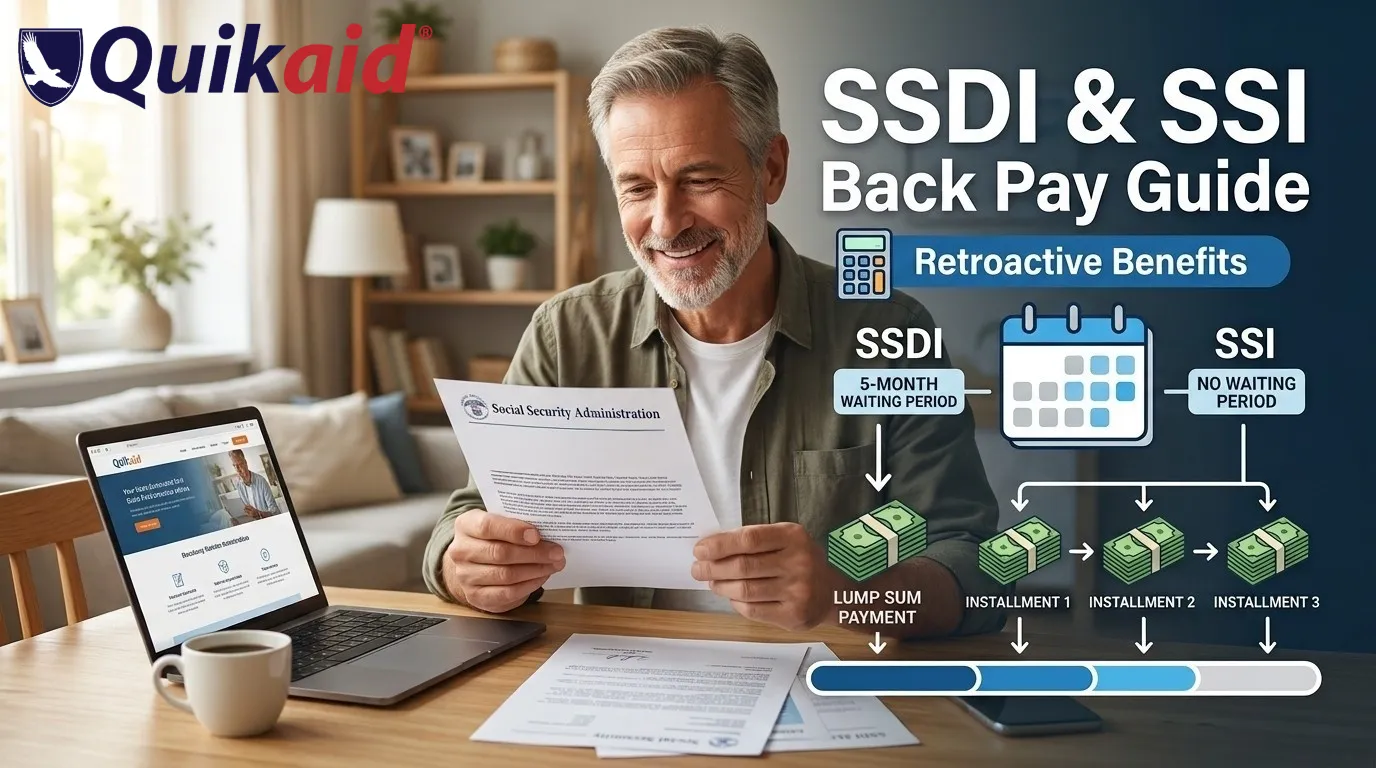
- SSDI back pay is limited by two rules: a 5-month waiting period and a 12-month retroactive limit before your application date. It's paid as one lump sum.
- SSI back pay has no waiting period, but large amounts are paid in up to three installments spaced six months apart, not as a lump sum.
- Retroactive SSI payments are excluded from your resource count for 9 months after you receive them, which protects your ongoing eligibility.
- Some sources split this payment into two terms: retroactive benefits for the months before you applied, and back pay for the months after. SSA generally treats it as one payment either way.
- If you received private long-term disability (LTD) insurance while your claim was pending, your LTD carrier may be entitled to reimbursement from your SSDI back pay.
- SSDI back pay can be taxable depending on your total income for the year. SSI back pay generally is not.
- Representation for a disability claim doesn't work like other legal services. Payment comes out of back pay only if you win, and the amount is capped by federal law.
- A representative can't speed up SSA's calculation, but making sure your onset date and work history are documented correctly is one of the biggest factors in how much back pay you actually receive.
What Is Back Pay, and Why Do You Get It?
SSA takes months, sometimes years, to decide a disability claim. During that wait, you're not receiving any benefit, even though your disability may have already kept you from working. Back pay is how SSA makes up for that gap. Once your case is approved, SSA calculates every month you were owed a payment but hadn't received one, and pays that amount out.
The formally correct term is past-due benefits, though back pay is the plain-language version SSA and the public both use. You'll see both terms throughout this guide.
Both SSDI and SSI include back pay, but the rules for calculating it, and the way it's paid out, are different enough that it's worth understanding each program on its own.
How SSDI Back Pay Is Calculated
Two dates matter for SSDI back pay. Your Alleged Onset Date (AOD) is the date you say your disability began. Your Established Onset Date (EOD) is the date SSA actually agrees your disability began, based on your medical evidence. These often match. When they don't, and SSA decides you became disabled later than you claimed, your EOD, not your AOD, is what your back pay is calculated from.
From there, two rules control how far back your payment can reach:
| Rule | What it means |
|---|---|
| 5-month waiting period | SSDI never pays for the first 5 full calendar months after your Established Onset Date. This applies to every SSDI claim, with a narrow exception for ALS. |
| 12-month retroactive limit | SSA can pay you for up to 12 months before your application date, but no further back than that, even if your EOD is earlier. |
A worked example. Say your Established Onset Date (EOD) is April 5, 2024. Because your EOD isn't the first of the month, April itself doesn't count toward your 5-month waiting period — the clock starts the next full month. That makes your waiting period May through September 2024, with your entitlement beginning October 2024. You applied on October 1, 2025, and were approved in June 2026. SSDI back pay can reach up to 12 months before your application date, which puts the earliest possible retroactive month at October 2024 — the same month your entitlement began. So your full entitlement period is covered, with no cut from the retroactive limit. That gives you 20 months of past-due benefits, from October 2024 through May 2026. At the 2026 average SSDI payment of about $1,635 a month, that back pay would total roughly $32,700. *Your own amount depends entirely on your earnings record, so use this as an illustration of how the math works, not a prediction.
SSDI back pay arrives as a single lump sum, separate from your first ongoing monthly check. It doesn't change your monthly benefit amount going forward.
Find Out How Much Back Pay You Could Be Owed!
Quikaid is America's Disability Experts®. We handle your entire claim — and you pay nothing unless you win.
Get a Free Case EvaluationBack Pay vs. Retroactive Benefits: Same Money, Two Names
You may see "back pay" and "retroactive benefits" used as if they're two different things. Most of the time they're not: SSA and most sources use both terms for the same past-due payment described above.
Some sources do draw a line between the two, though, and it's worth knowing that split exists so it doesn't throw you off if you come across it elsewhere.
- Retroactive benefits, in this narrower usage, cover the months between your Established Onset Date and your application date, capped at 12 months.
- Back pay, in this narrower usage, covers the months between your application date and your approval date, with no separate 12-month cap of its own beyond however long your claim took.
Add the two together and you land on the same total this guide has been walking through the whole way. The split is a way of describing where the money comes from, not a separate calculation or a separate check. Either way, it's part of the same lump sum for SSDI, or the same installment schedule for SSI.
How SSI Back Pay Works
SSI has no 5-month waiting period. Your back pay starts accruing the month after you apply, or in some cases the date SSA determines your disability began, whichever rule applies to your situation.
The difference shows up in how the money is paid. Because SSI is a needs-based program with strict resource limits, SSA doesn't hand over a large lump sum all at once. When your past-due SSI benefit is more than three times the monthly Federal Benefit Rate, currently $994 for an individual in 2026, SSA pays it out in up to three installments, generally spaced six months apart. The first two installments are each capped at that three-times-the-rate amount, and the final installment includes whatever is left.
There are exceptions. If you have documented debts or expenses for things like housing, food, or medical care, SSA can increase an installment to cover them. And if you have a medical condition expected to result in death within 12 months, the installment requirement doesn't apply at all, and you can receive the full amount at once.
Why the resource limit matters here. SSI eligibility depends on staying under a resource limit of $2,000 for an individual. A large back pay deposit could push you over that limit and put your ongoing benefits at risk. To prevent that, SSA excludes the unspent portion of a retroactive SSI payment from your countable resources for 9 months after you receive it. Once that 9-month window closes, whatever is left over does count toward your resource limit, so it's worth planning ahead for how you'll use or save the money.
SSDI vs. SSI Back Pay at a Glance
| SSDI | SSI | |
|---|---|---|
| Payment method | Single lump sum | Up to 3 installments, 6 months apart |
| Waiting period | 5 months | None |
| Farthest look-back | 12 months before application | Starts the month after you apply |
| Resource protection | Not applicable | 9-month exclusion from resource limit |
You generally can't receive back pay from both programs for the same period. If you're approved for a concurrent claim, where your low SSDI amount also qualifies you for SSI, Quikaid's guide on receiving both SSDI and SSI covers how the two back pay calculations interact.
When Will You Receive Your Back Pay?
SSA doesn't publish one official timeline for every case, but most approved claimants receive their first payment, including back pay, within 30 to 90 days of a favorable decision, often closer to 60 days. A few things affect where you land in that range: how current your banking information is with SSA, whether your case went through an appeal or hearing, and how quickly SSA's payment center processes your file after your Notice of Award goes out.
SSI recipients sometimes wait a little longer than SSDI recipients for that first payment. Before releasing SSI back pay, SSA runs a final check of your income and resources to confirm you're still within the program's limits, and that check can add time before your first installment goes out.
Federal law now requires nearly all federal benefit payments, including SSDI and SSI, to be made electronically rather than by paper check. Keeping your direct deposit information current with SSA is one of the simplest ways to avoid an avoidable delay.
Struggling to get approved for SSDI?
Quikaid is America's Disability Experts®. We handle your entire claim — and you pay nothing unless you win.
Get a Free Case Evaluation Sign Our Contract OnlineIs Back Pay Taxable?
It depends on the program and your total income for the year.
SSDI back pay can be subject to federal income tax, even though your regular monthly SSDI payments usually are not taxed unless your overall income is high enough. Because back pay often arrives as one large lump sum covering many months at once, it can push your reported income for the year above the threshold where a portion becomes taxable. The IRS allows a lump sum election method that lets you spread a back pay award across the years it was actually owed for tax purposes, which can lower what you owe. A tax professional can tell you whether that applies to your situation.
SSI back pay is generally not taxable, since SSI is a needs-based program rather than an earned benefit.
What Affects the Amount of Back Pay You Receive
A few situations commonly change the final number.
- Primary Insurance Amount (PIA). Your SSDI benefit amount is based primarily on your Social Security-covered earnings history. Generally, the more you earned over your working years, the higher your monthly SSDI benefit amount will be, up to Social Security's maximum benefit amount.
- SSI Federal Standard Monthly Payment Amount. For SSI there is a federal standard monthly payment amount that is currently $994 per month for an eligible individual and $1,491 per month for an eligible couple. *These amounts can be adjusted downward based on household income, resources, living arrangements, etc., since SSI is a "needs-based" program.
- Additional state Supplements. There are "state Supplements" in specific states that add an extra cash Supplement to the federal payment amount.
- Working while your claim was pending. Income you earned while waiting for a decision can affect your onset date for SSDI, or reduce your monthly amount and back pay for SSI.
- Workers' compensation or other public disability benefits. SSA can offset, or reduce, your back pay based on what you've received from these sources for the same period.
- An incorrect onset date. If SSA sets your Established Onset Date later than the medical evidence supports, your back pay shrinks, sometimes by thousands of dollars, without you necessarily knowing why.
- Appeals. A longer path to approval, through reconsideration or a hearing, usually means a longer back pay period, since the months you were waiting keep accruing.
- Long-term disability (LTD) insurance. If you received private LTD benefits through an employer while your SSDI claim was pending, your LTD policy may require you to reimburse some or all of it once your back pay arrives.
If you're currently receiving LTD while you wait on an SSDI decision, it's worth checking your policy or asking your LTD carrier whether it includes an offset provision. Many employer LTD plans require reimbursement for exactly this reason: your SSDI back pay covers some of the same months your LTD benefit already paid you for. The amount you'd owe back generally won't exceed what you receive from SSDI, but it's a good reason to hold off on spending your back pay right away until you know whether a reimbursement request is coming.
How Quikaid Can Help
Since 1993, Quikaid has helped over 250,000 people pursue the Social Security disability benefits they've earned. Quikaid is a Social Security disability representation firm, not a law firm, and its team includes both licensed attorneys and SSA-authorized non-attorney representatives who focus exclusively on SSDI and SSI claims.
A representative can't change SSA's calculation formula or its processing timeline. What a representative can do is make sure your Established Onset Date is supported by the medical evidence, your work history is documented accurately, and nothing in your file causes SSA to shorten the period you're owed. Quikaid also follows up after approval to help confirm your back pay and ongoing benefit were calculated correctly.
You're 3x more likely to be approved for disability benefits with an expert representative in your corner.
We don't require a retainer. There's no hourly billing, and Quikaid can talk through your situation right away.
Frequently Asked Questions (FAQs)
How does the Social Security Administration calculate back pay for SSDI?
SSA starts from your Established Onset Date, applies a mandatory 5-month waiting period, and pays you from the month after that period ends through the month before your approval, capped at 12 months of retroactivity before your application date.
How does the Social Security Administration calculate back pay for SSI?
SSI back pay starts accruing the month after you apply, with no waiting period. If the total past-due amount is more than three times the monthly Federal Benefit Rate, it's paid out in up to three installments spaced six months apart instead of all at once.
How long does it take to receive back pay after approval?
Most approved claimants receive their first payment, including back pay, within 30 to 90 days of a favorable decision, often around 60 days, depending on your banking information and how your case was processed.
Is SSDI or SSI back pay taxable?
SSDI back pay can be taxable depending on your total income for the year, even though ongoing monthly SSDI usually isn't. SSI back pay is generally not taxable. A tax professional can walk through your specific situation.
Can you receive back pay from both SSDI and SSI?
Generally not for the same period under the same program rules, but if you're approved for a concurrent claim, where a low SSDI amount also qualifies you for SSI, both programs' back pay rules can apply to your situation. Our guide on receiving both SSDI and SSI covers how that works.
What if I worked while my claim was pending?
Any income earned while you were waiting for a decision can affect your case. For SSDI, it can shift your onset date. For SSI, earned income reduces your monthly amount and your back pay for that period.
What's the difference between back pay and retroactive benefits?
Often, nothing. SSA and most sources use both terms for the same past-due payment. Where a distinction is drawn, retroactive benefits refer to the months before you applied, capped at 12 months, and back pay refers to the months between your application and your approval. Add them together and you get the same total either way.
*All SSDI and SSI claims are subject to Social Security Administration review and approval. Past results do not guarantee future outcomes. Quikaid's fee is regulated by the SSA and only applies if your claim is approved. The free case evaluation is provided at no obligation.
This article has been reviewed and approved by Quikaid staff, many of whom previously worked at the Social Security Administration in leadership positions within the disability adjudication process.

External Sources Cited In This Article
- SSA, disability program overview
- USA.gov, Social Security disability overview
- NCOA, who is eligible for SSDI
- SSA, Representing SSA Claimants overview, fee agreement cap
- SSA, POMS SI 01130.600, retroactive SSI and RSDI payment resource exclusion
- SSA, 20 CFR 416.1233, 9-month exclusion of retroactive payments from resources
- SSA, POMS SI 02101.020, installment payments of large past-due SSI benefits
- SSA, direct deposit and electronic payment requirement
Share via:
HIRE AMERICA'S DISABILITY EXPERTS NOW
If you need disability benefits, hire Quikaid now. You will not regret it. We will do everything possible to get your claim approved.
Sign our contract now online, complete our Free Case Evaluation, or call (800) 941-1321 so we can start the process of getting you approved for benefits! You have nothing to lose, and everything to gain.
The time to get started is NOW!