




SSDI/SSI Eligibility Checklist and Quiz
Disability Checklist
Do I Qualify for SSDI or SSI? The Short Answer
You likely qualify for disability if a doctor confirms your condition will last at least 12 months (or is terminal), and that condition keeps you from working. From there, which program you qualify for — SSDI, SSI, or both — comes down to your work history and your household finances.
SSDI (Social Security Disability Insurance) is an earned benefit. You paid into it through payroll taxes, so it's based on your work record, not your income. SSI (Supplemental Security Income) is based on financial need, not work history, so it's available even if you've never worked.
Use the checklists and quiz below to get a fast read on where you stand. Then get a free case evaluation — it takes under a minute, and there's no fee unless you win your claim.
Key Takeaways (UPDATED: August 5, 2026)
-
SSDI is based on your work history. SSI is based on financial need. You could qualify for one, both, or neither — this article helps you figure out which.
-
Both programs use the same medical test: your condition must be severe enough to keep you from working for at least 12 months, or be expected to result in death.
-
In 2026, the substantial gainful activity (SGA) limit is $1,690 a month ($2,830 if you're blind). Earning more than that can affect your claim.
-
SSI's resource limit is $2,000 for an individual and $3,000 for a couple — unchanged since 1989.
-
A denial is not the end of the road. Most people who get approved were denied at least once first.
Which Disability Program Is The Right Fit?
SSDI vs. SSI at a Glance
| SSDI | SSI | |
| Who it's for | Workers with enough Social Security taxes paid | Anyone with very limited income and resources |
| Work history required | Yes — 40 work credits, 20 earned in the last 10 years (less if you're under 31) | No work history required |
| Income/resource limits | No asset limit; earnings must stay under the SGA threshold | $2,000 (individual) or $3,000 (couple) in resources |
| 2026 monthly benefit | Based on your lifetime earnings — varies by person (up to $4,152) | $994 (individual) or $1,491 (couple) federal rate |
| Healthcare that comes with it | Medicare (after a 24-month waiting period) | Medicaid, often immediately |
You can qualify for both SSDI and SSI at once — called a "concurrent claim" — if you have some work credits but your SSDI payment is low enough that you still meet SSI's income limit.
The SSDI Eligibility Checklist
Check every box that applies to you:
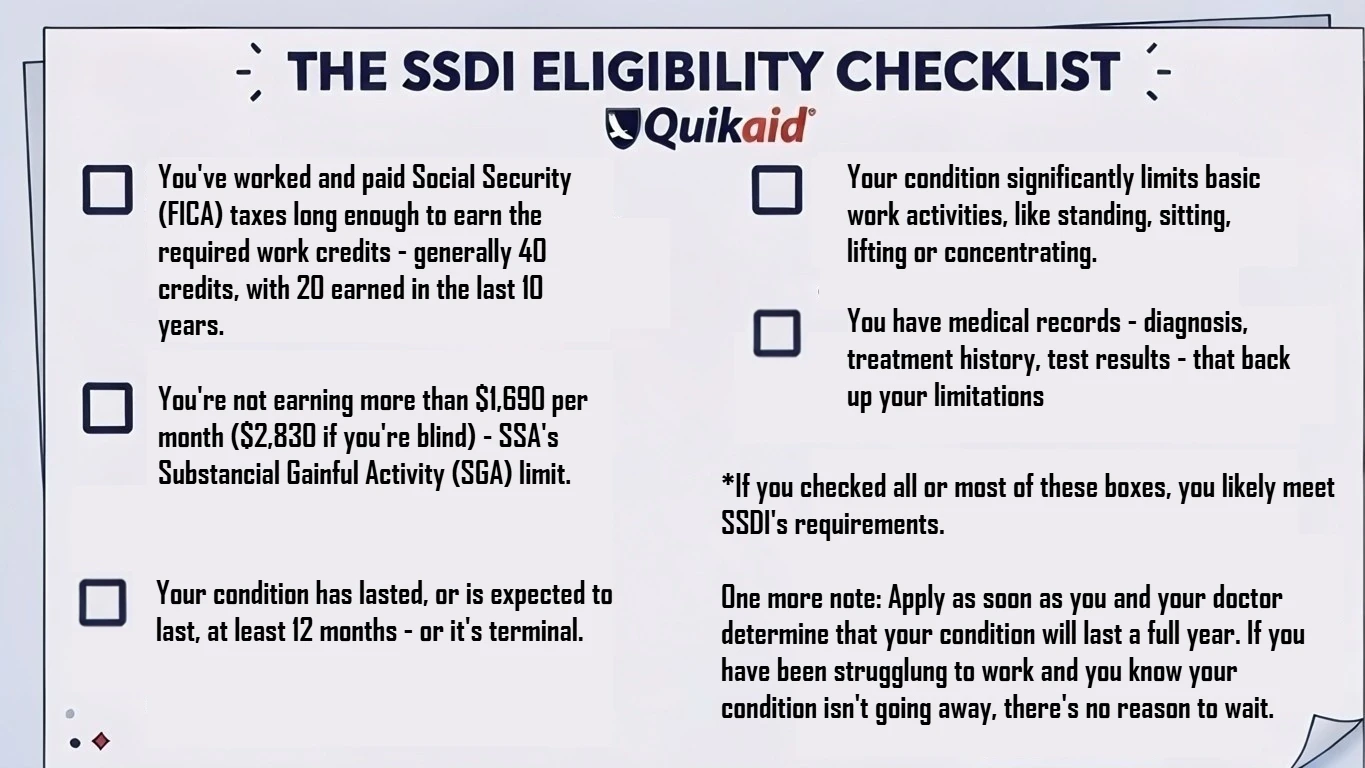
If you checked most or all of these boxes, you likely meet SSDI's basic requirements. One more note: apply as soon as you and your doctors agree your condition will last a full year. If you've been struggling to work and know your condition isn't going away, there's no reason to wait.
The SSI Eligibility Checklist
Check every box that applies to you:
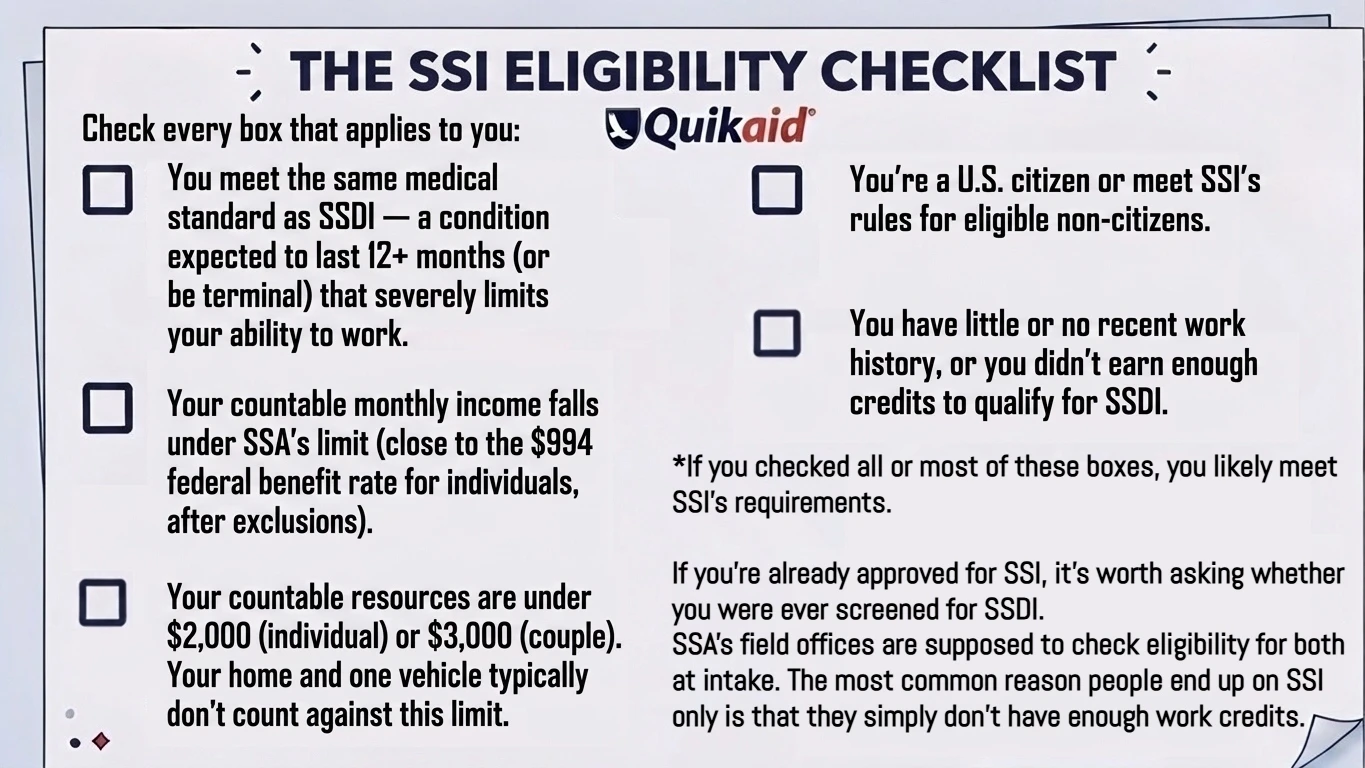
If you're already approved for SSI, it's worth asking whether you were ever screened for SSDI. SSA's field offices are supposed to check both at intake, but the most common reason people end up on SSI only is that they simply didn't have enough work credits. If you're not sure, call your local Social Security field office or SSA directly at (800) 772-1213 to confirm.
Take the 60-Second Eligibility Quiz
Answer yes or no to these questions:
-
Has a doctor said your condition will last at least a year, or could be terminal?
-
Are you currently unable to work, or working under the SGA limit ($1,690/month in 2026)?
-
Have you worked and paid Social Security taxes in at least 5 of the last 10 years?
-
Is your household income and savings very limited — under about $2,000 in resources?
-
Do you have medical records documenting your diagnosis and treatment?
-
Have you already been denied once, and you're not sure whether to reapply or appeal?
How to read your answers:
-
Yes on 1, 2, and 5: You likely meet the core medical requirements. A free case evaluation can confirm your next step.
-
Yes on 3: SSDI is probably your path.
-
Yes on 4, no on 3: SSI may be the better fit for your situation.
-
Yes on 6: Don't wait. Most people who eventually get approved were denied at least once — a denial isn't a verdict on your eligibility, and there's usually a 60-day window to act.
What to Do Once You've Checked the Boxes
Checking these boxes is the first step, not the last one. The next step is gathering your medical records and getting a free case evaluation. From there, Quikaid handles the parts that overwhelm most applicants: preparing your application, collecting medical evidence, and communicating with SSA on your behalf.
There's no retainer and no fee unless you win your claim. We also pay for the incidental costs along the way — medical records, postage, copying — so you never get a bill, win or lose.
3 Myths About Disability Eligibility, Busted
"My condition isn't on SSA's list, so I don't qualify." Not true. SSA looks at how severe your symptoms are and how well your medical evidence supports them — not just your diagnosis.
"I was denied once, so I'm ineligible." Not true. Roughly two out of three initial applications are denied. A denial often reflects missing paperwork or evidence, not a final judgment on your case.
"I can't work at all to qualify." Not quite. SSA's rule is about earning above the SGA limit, not total incapacity. Some limited work activity is possible without automatically disqualifying your claim — though any work can affect how your claim is viewed, so it's worth discussing your specific situation.
Frequently Asked Questions (FAQs)
Can I qualify for both SSDI and SSI at the same time?
Yes. This is called a concurrent claim. It applies if you have enough work credits for SSDI, but your monthly SSDI payment is low enough that you still meet SSI's income and resource limits.
I'm already on SSI. Can I get SSDI too?
SSDI is based on how much you worked and paid into Social Security. When you were approved for SSI, SSA's field office should have screened you for SSDI eligibility — most likely, you didn't have enough work credits to be insured.
Can I work part-time and still qualify for disability?
It depends on your earnings and the nature of the work. Earning under the SGA limit ($1,690/month in 2026) doesn't automatically disqualify you, but any work activity can affect how SSA views your claim, so it's important to understand the rules before you start or continue working.
Does my diagnosis need to match an SSA "listing" to qualify?
No. SSA's listings are one way to qualify, but many people are approved based on the overall severity of their symptoms and how those symptoms limit their ability to work — not because their exact diagnosis appears on a list.
What if I don't have enough work credits for SSDI and don't meet SSI's income limits either?
This is uncommon, but it can happen — for example, if your household income is too high for SSI but you haven't worked enough for SSDI. A free case evaluation can walk through your specific numbers and confirm where you stand.
You Don't Have to Figure This Out Alone
If you checked several boxes above, it's worth finding out for certain. Quikaid has helped roughly 50,000 clients win more than $1.5 billion in benefits since 1993 — and we don't get paid until you do. Get your free case evaluation today. It takes under a minute, and you have nothing to lose.
Struggling to get approved for SSDI?
Quikaid is America's Disability Experts®. We handle your entire claim — and you pay nothing unless you win.
Get a Free Case Evaluation Sign Our Contract Online
Share via:
HIRE AMERICA'S DISABILITY EXPERTS NOW
If you need disability benefits, hire Quikaid now. You will not regret it. We will do everything possible to get your claim approved.
Sign our contract now online, complete our Free Case Evaluation, or call (800) 941-1321 so we can start the process of getting you approved for benefits! You have nothing to lose, and everything to gain.
The time to get started is NOW!