




Social Security Disability Blue Book: Complete Medical Conditions Index

SSA Disability Blue Book
What Is the Social Security Disability Blue Book?
The "Blue Book" is the nickname for Disability Evaluation Under Social Security, the official manual the Social Security Administration (SSA) uses to decide who qualifies as medically disabled. Disability examiners use it every day. You can use it, too — this page organizes it into a plain-language index by body system, so you can find where your condition fits without digging through the technical version yourself.
Think of it as the medical rulebook examiners work from — not a form you fill out. You never submit the Blue Book to SSA. Your job is medical evidence; SSA's job is to measure that evidence against the Blue Book's criteria.
Key Takeaways (Published: August 10, 2026)
- The Blue Book is the SSA's official list of medical conditions and the severity rules examiners use to decide disability claims. Its real title is Disability Evaluation Under Social Security.
- It's organized into 14 body systems, from musculoskeletal disorders to cancer to mental disorders.
- You don't have to match a listing word-for-word to get approved. Most approved claims are decided on medical-vocational grounds, not an exact listing match.
- Certain severe conditions qualify for Compassionate Allowances, which can speed up approval to weeks instead of months.
- If your condition isn't listed at all, you can still qualify — SSA will look at how it limits your ability to work.
How the Blue Book Fits Into SSA's 5-Step Evaluation
SSA doesn't jump straight to the Blue Book. It works through five questions in order, and most claims are decided at step 3 or step 5.
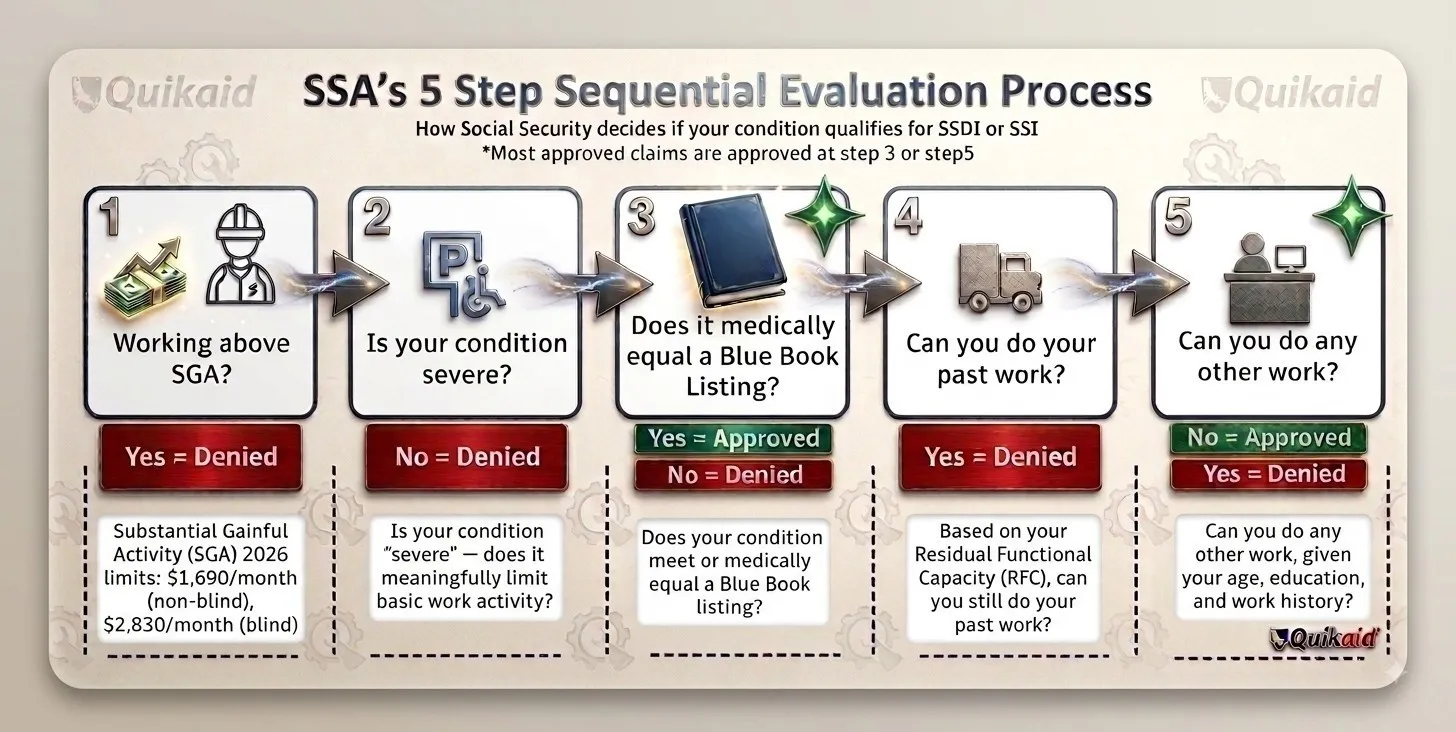
| Step | Question | If the answer flips the claim |
|---|---|---|
| 1 | Are you working above the Substantial Gainful Activity (SGA) limit? 2026 limits: $1,690/month (non-blind), $2,830/month (blind) | Yes → denied |
| 2 | Is your condition "severe" — does it meaningfully limit basic work activity? | No → denied |
| 3 | Does it meet or medically equal a Blue Book listing? | Yes → approved |
| 4 | Based on your Residual Functional Capacity (RFC), can you still do your past work? | Yes → denied |
| 5 | Can you do any other work, given your age, education, and work history? | No → approved |
Source: SSA, How We Decide If You Are Disabled; SGA figures verified against SSA's 2026 SGA/COLA table.
The Blue Book only comes into play at step 3. If your condition doesn't match a listing exactly, your claim doesn't end there — it moves to steps 4 and 5, where SSA looks at what you can still do, not just your diagnosis. This is the single most misunderstood part of the process, and it's why "my condition isn't in the Blue Book" is not the same as "I don't qualify."
The Complete Body System Index
The Blue Book Adult Listings are organized into 14 body systems. Below is a plain-language index of each one, with common examples. This isn't every condition SSA evaluates — it's a starting map to help you find where yours likely falls.
| # | Body System | What It Covers | Common Examples |
|---|---|---|---|
| 1 | Musculoskeletal Disorders | Bones, joints, muscles, spine, and connective tissue | Degenerative disc disease, severe arthritis, amputation, spinal stenosis |
| 2 | Special Senses and Speech | Vision, hearing, and speech impairments | Blindness, severe hearing loss, loss of speech |
| 3 | Respiratory Disorders | Lungs and breathing | COPD, chronic asthma, pulmonary fibrosis, cystic fibrosis |
| 4 | Cardiovascular System | Heart and circulatory system | Chronic heart failure, coronary artery disease, recurrent arrhythmias |
| 5 | Digestive System | Liver, pancreas, and GI tract | Crohn's disease, chronic liver disease, inflammatory bowel disease |
| 6 | Genitourinary Disorders | Kidneys and urinary system | Chronic kidney disease, dialysis-dependent conditions |
| 7 | Hematological Disorders | Blood and bone marrow | Sickle cell disease, hemophilia, bone marrow failure |
| 8 | Skin Disorders | Skin conditions and severe burns | Third- and fourth-degree burns, chronic severe psoriasis |
| 9 | Endocrine Disorders | Hormone-producing glands | Diabetes complications, thyroid disease, adrenal disorders |
| 10 | Congenital Disorders | Conditions affecting multiple body systems from birth | Down syndrome and related multi-system congenital conditions |
| 11 | Neurological Disorders | Brain, spinal cord, and nerves | Epilepsy, Parkinson's disease, multiple sclerosis, ALS, stroke |
| 12 | Mental Disorders | Cognitive, mood, and psychiatric conditions | Major depression, schizophrenia, PTSD, autism spectrum disorder |
| 13 | Cancer (Malignant Neoplastic Diseases) | All cancers except those tied to HIV | Lymphoma, leukemia, and cancers evaluated by stage and spread |
| 14 | Immune System Disorders | Autoimmune and immune deficiency conditions | Lupus, rheumatoid arthritis, HIV |
Compassionate Allowances: The Fast-Track List
Some conditions are so consistently severe that SSA doesn't make people wait through the full review process. These are called Compassionate Allowances (CAL) — SSA's list of conditions that are presumed to meet disability standards, so decisions can come back in weeks instead of months.
As of SSA's most recent published list, there are more than 300 conditions on the CAL list, including many aggressive cancers, early-onset Alzheimer's, ALS, and a range of rare pediatric disorders. SSA reviews and expands this list on an ongoing basis, so the exact count changes over time — check the current CAL list directly for the latest version.
A CAL diagnosis speeds up processing, not the evidence requirement. You still need medical records confirming the diagnosis. It's a faster lane, not a different set of rules.
A related fast-track category is TERI cases — claims involving a terminal illness. SSA flags and prioritizes these so decisions don't get stuck behind a routine backlog.
What If Your Condition Isn't in the Blue Book?
This is the question that stops a lot of people from applying at all — and it shouldn't.
Not being listed does not mean you don't qualify. Go back to the 5-step process above: if step 3 doesn't produce an automatic match, your disability claim moves to steps 4 and 5. There, SSA builds a Residual Functional Capacity (RFC) assessment — a detailed picture of what you can still physically and mentally do — and weighs it against your age, education, and work history.
In practice, this is how a large share of approved SSDI and SSI claims actually get approved: not through a listing match, but through evidence that the combination of a person's limitations rules out both their past work and any other realistic work. A rare or newly recognized condition, a combination of several conditions that add up to disabling, or symptoms that don't fit neatly into one Blue Book category can all still result in approval — if the medical evidence supports it.
How Quikaid Can Help
Reading Blue Book criteria is one thing. Knowing how an SSA examiner actually applies them to a real case is another — and that's where focusing our team's expertise exclusively on Social Security Disability since 1993 gives Quikaid a distinct advantage when it comes to disability applications and appeals.
Quikaid has helped over 250,000 clients with their SSDI and SSI benefits claims since 1993, and our team includes representatives who previously worked as SSA and DDS claims examiners — the same evaluators who apply Blue Book listings every day. We know what evidence an examiner needs to see, and we know how to frame a claim so it gets read the way it should be.
There's no upfront cost. We don't get paid unless you win, our fee is capped by SSA at 25% of back pay, and we cover your medical records and paperwork costs ourselves — we never bill clients for them. A denial isn't the end of the road, and an unlisted condition isn't either.
Frequently Asked Questions (FAQs)
What is the Social Security Blue Book?
It's the SSA's official manual, Disability Evaluation Under Social Security, listing the medical conditions and severity criteria examiners use to decide disability claims.
Do I need to match a Blue Book listing exactly to get approved?
No. Most approved claims are decided by showing your condition, or combination of conditions, prevents you from doing your past work or any other work — not by matching a listing word-for-word.
What conditions automatically qualify for disability?
No diagnosis automatically qualifies on its own. Conditions on the Compassionate Allowances list are fast-tracked for a quicker decision, but you still need medical evidence confirming the diagnosis and its severity.
What is the Compassionate Allowances program?
It's an SSA program that identifies conditions severe enough to typically meet disability standards, allowing decisions in weeks rather than months. See the current list on ssa.gov.
llWhat happens if my diagnosis isn't in the Blue Book?
Your claim isn't automatically denied. SSA evaluates your Residual Functional Capacity — what you can still do — against your age, education, and work history to decide if you qualify.
Is the Blue Book the same for SSDI and SSI?
The medical criteria are the same for both programs. SSDI and SSI differ in their non-medical requirements — SSDI is based on work credits, while SSI is based on income and resources.
How often does SSA update the Blue Book?
SSA reviews and revises listings on an ongoing basis, and updates the Compassionate Allowances list periodically as well. Always check ssa.gov for the current version rather than relying on an older printed copy..
The Bottom Line
The Blue Book isn't something you need to master on your own. It's a reference tool — one that tells you what SSA examiners are looking for, not a checklist you have to complete perfectly. Whether your condition matches a listing exactly, falls into a Compassionate Allowance, or doesn't appear in the Blue Book at all, the same thing decides your claim: medical evidence that clearly shows how your condition limits your ability to work.
That's the part worth focusing your energy on. Keep up with your treatment, make sure your medical records tell the full story, and don't assume a denial or an unlisted diagnosis is the end of the road — for most people, it isn't.
If you're not sure where your condition fits or what evidence your claim needs, that's exactly what a representative who works Blue Book listings every day is for.
Struggling to get approved for SSDI?
Quikaid is America's Disability Experts®. We handle your entire claim — and you pay nothing unless you win.
Get a Free Case Evaluation Sign Our Contract OnlineThis article has been reviewed and approved by Quikaid staff, many of whom previously worked at the Social Security Administration in leadership positions within the disability adjudication process.

Sources
- Social Security Administration, Disability Evaluation Under Social Security (Blue Book, Adult Listings)
- Social Security Administration, Compassionate Allowances: Complete List of Conditions
- Social Security Administration, 2026 Substantial Gainful Activity (SGA) and COLA figures
- Social Security Administration, Disability Benefits Overview
Share via:
HIRE AMERICA'S DISABILITY EXPERTS NOW
If you need disability benefits, hire Quikaid now. You will not regret it. We will do everything possible to get your claim approved.
Sign our contract now online, complete our Free Case Evaluation, or call (800) 941-1321 so we can start the process of getting you approved for benefits! You have nothing to lose, and everything to gain.
The time to get started is NOW!