



Disability Qualification Requirements by State: A Complete 2026 Guide
Disability Qualifications By State
What's Needed For Disability Qualification?
Quick Answer
Most people assume disability qualification rules change from state to state. They don't — at least not for the benefit most people need. Social Security Disability Insurance (SSDI) and Supplemental Security Income (SSI) use the exact same rules no matter where you live. Only your local Social Security office changes, not the standard you're judged against.
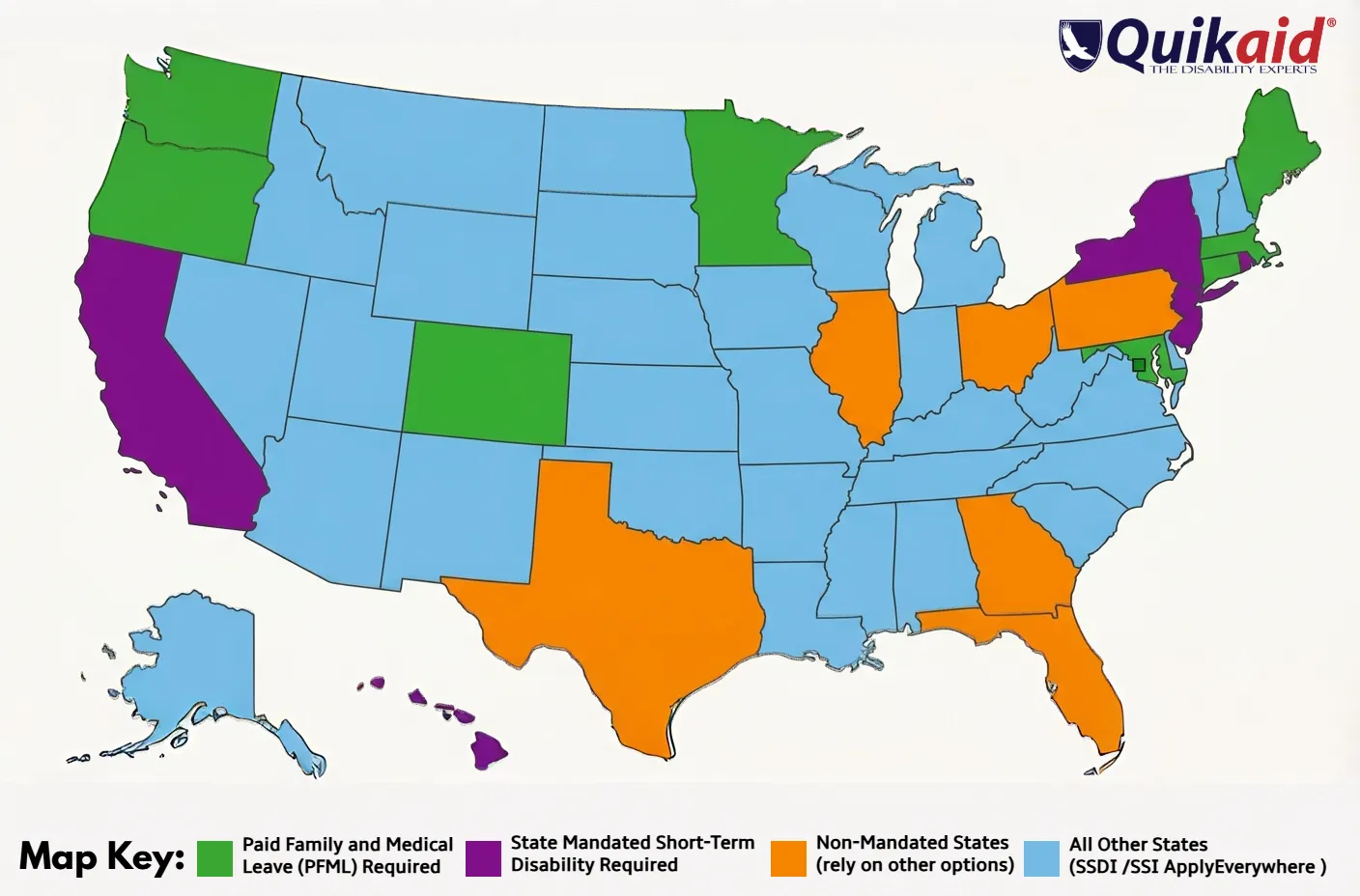
What does change by state is short-term disability coverage. Only five states — California, Hawaii, New Jersey, New York, and Rhode Island — require employers to offer short-term disability insurance. Everyone else relies on federal SSDI/SSI, an employer plan, or private coverage.
Quikaid has helped over 250,000 people work through exactly this confusion since 1993. Below, we break down every layer — federal, state, and employer — so you know exactly where you stand.
Key Takeaways (Published: August 6, 2026)
- Federal disability rules (SSDI and SSI) are identical in all 50 states. Only the office that processes your paperwork changes.
- Only 5 states require short-term disability insurance: California, Hawaii, New Jersey, New York, and Rhode Island.
- The 2026 SGA limit is $1,690/month for most applicants ($2,830/month if you're blind) — earning above this can get an SSDI claim denied.
- A growing list of states — Colorado, Connecticut, Massachusetts, Maine, Maryland, Minnesota, Oregon, Washington, and Washington, D.C. — now require Paid Family & Medical Leave, a different kind of coverage than traditional short-term disability.
- Representation matters. Applicants who work with a representative are statistically far more likely to be approved than those who go it alone.
- Your diagnosis alone doesn't decide your case. SSA looks at how severely your combination of conditions limits your ability to work — not which condition you have.
How Disability Qualification Actually Works
People often search "do I qualify for disability" expecting one answer. In reality, there are three separate systems, and which one applies to you depends on your situation, not your state.
| Program Type | Who Runs It | Where It Applies |
|---|---|---|
| Federal SSDI / SSI | Social Security Administration (SSA) | All 50 states — same rules everywhere |
| State-mandated short-term disability | State labor/employment agencies | Only CA, HI, NJ, NY, RI |
| Employer or private disability insurance | Employers / private insurers | Available anywhere, but optional and varies by policy |
If your condition is expected to last a year or longer (or is terminal), you're likely looking at federal SSDI or SSI — the same everywhere. If you need shorter-term wage replacement and you work in one of the five states above, a state program may apply first. Everyone else typically relies on an employer plan, private coverage, or federal disability if the condition becomes long-term.
Federal SSDI & SSI Qualification Rules
(Same in All 50 States)
SSDI: Based on Your Work History
SSDI is designed for people who've paid into Social Security through payroll taxes and can no longer work due to a medical condition.
To qualify, you generally need:
- Enough work credits. Most adults need 40 credits total, with 20 earned in the last 10 years before becoming disabled. Younger workers can qualify with fewer credits. In 2026, you earn one credit for every $1,890 in wages, up to four credits per year.
- A condition that meets SSA's medical definition of disability. Your condition must prevent you from doing substantial work and must be expected to last at least 12 months or result in death.
- Earnings below the Substantial Gainful Activity (SGA) limit. For 2026, that's $1,690 per month for most applicants, or $2,830 per month if you're statutorily blind. Earning more than this is one of the most common reasons claims get denied at the very first step of review.
SSI: Based on Financial Need
SSI uses the same medical disability standard as SSDI, but eligibility is financial rather than work-history based.
To qualify, you generally need:
- Limited income and resources. Countable assets must stay under $2,000 for an individual or $3,000 for a couple.
- To meet the same disability definition used for SSDI — inability to work for at least 12 months due to your medical condition(s).
- The 2026 Federal Benefit Rate is $994 per month for an individual and $1,491 per month for a couple, though your actual payment depends on other income you receive.
Both programs are processed through your local Social Security field office and state Disability Determination Services (DDS) office — but the medical and financial standards applied are federal. A DDS examiner in Texas and one in Ohio are applying the exact same rulebook.
State-Mandated Short-Term Disability Programs
Five states require employers to provide short-term disability coverage for off-the-job illness or injury. These programs are meant to bridge shorter absences — they are not a substitute for SSDI if your condition turns out to be long-term.
| State | Program Name | General Eligibility | Max Duration | 2026 Weekly Benefit |
|---|---|---|---|---|
| California | State Disability Insurance (SDI) | Earned at least $300 in wages during your base period; unable to work at least 8 consecutive days; medically certified | Up to 52 weeks | $50–$1,765 |
| Hawaii | Temporary Disability Insurance (TDI) | Worked at least 14 consecutive weeks for the same employer, 20+ hours/week | Up to 26 weeks | Up to $871 |
| New Jersey | Temporary Disability Insurance (TDI) | Meets a base-year earnings threshold set by the state (adjusts annually) | Up to 26 weeks | Up to roughly $1,119 |
| New York | Disability Benefits Law (DBL) | Employed at least 4 consecutive weeks full-time (or 25 days part-time) with a covered employer | Up to 26 weeks | Up to $170 |
| Rhode Island | Temporary Disability Insurance (TDI) | Earned at least $19,200 in your base period, or met an alternate earnings test | Up to 30 weeks | $148–$1,150 |
A note on New York: its $170 weekly cap hasn't changed since 1989 and is significantly lower than the other four states — worth knowing if you're comparing coverage across state lines.
Important: These programs are separate from SSDI and SSI. If your condition improves within the program's benefit window, you may not need federal disability at all. If it doesn't, SSDI or SSI becomes the next step.
Paid Family & Medical Leave States (A Newer, Related Category)
A separate and growing group of states require Paid Family and Medical Leave (PFML) instead of — or alongside — traditional short-term disability insurance. PFML typically covers your own serious health condition as well as caregiving and bonding leave.
States with active PFML programs include:
- Colorado
- Connecticut
- Massachusetts
- Maine
- Maryland
- Minnesota
- Oregon
- Washington
- Washington, D.C.
Eligibility is usually based on hours worked or wages earned over a 12-month period, and the exact thresholds vary and change from year to year. Because these figures shift often, check your state's PFML program directly for the current requirement rather than relying on a fixed number.
All Other States: What Residents Rely On
If you live in a state without a mandatory short-term disability or PFML program — including Texas, Florida, Ohio, Georgia, Illinois, and Pennsylvania — you generally have three options:
- Employer-sponsored short- or long-term disability plans, if your employer offers one. Eligibility depends entirely on the policy's terms.
- Individual private disability insurance, purchased directly from an insurer.
- Federal SSDI or SSI, if your condition is severe enough to keep you from working for 12 months or longer — the same federal standard that applies everywhere else in the country.
For most residents of these states, SSDI and SSI end up being the primary safety net, which is why understanding the federal rules above matters more here than anywhere else.
Common Reasons People Get Disqualified — or Think They Are, Incorrectly
- Earning above the SGA limit, even from part-time work. In 2026, that's $1,690/month for most applicants.
- Not having enough work credits for SSDI specifically (this doesn't affect SSI, which is need-based).
- Assuming a specific diagnosis automatically qualifies or disqualifies them. SSA doesn't approve or deny based on the name of your condition — it looks at whether the severity of your symptoms, alone or combined with other conditions, keeps you from working for at least 12 months.
- Applying too early, before a doctor has confirmed the condition is expected to last a full year.
Not sure where you personally stand? Our SSDI/SSI Eligibility Checklist and Quiz walks through your situation point by point and gives you a fast read on which program fits.
How Quikaid Helps
Quikaid has focused exclusively on Social Security disability representation since 1993 — no personal injury cases, no workers' comp, no distractions. That focus means the team knows exactly what SSA needs to see in an application, an appeal, or a hearing.
There's no fee unless your disability claim is approved, no retainer, and no upfront cost. Quikaid pays for medical records, postage, and every incidental expense out of its own pocket, win or lose. Our fee is 25% of your past-due benefits, capped at $9,200, set by Social Security — not by us.
A free case evaluation takes under a minute to start.
Frequently Asked Questions (FAQs)
Do disability qualification rules differ by state?
Federal SSDI and SSI rules are identical in every state. What differs by state is short-term disability coverage — only California, Hawaii, New Jersey, New York, and Rhode Island require it, and a separate group of states require Paid Family & Medical Leave instead.
What's the difference between SSDI and SSI qualification?
SSDI eligibility is based on your work history and how much you've paid into Social Security. SSI eligibility is based on financial need — limited income and resources — using the same medical disability standard as SSDI.
Which states have mandatory short-term disability insurance?
California, Hawaii, New Jersey, New York, and Rhode Island. Every other state leaves short-term coverage up to employers or individuals.
What is Substantial Gainful Activity (SGA) and how does it affect eligibility?
SGA is the monthly earnings limit SSA uses to decide if you're capable of working. For 2026, it's $1,690/month for most applicants and $2,830/month if you're blind. Earning above this limit can result in a denial.
Can I qualify for disability if I've never applied before?
Yes. There's no requirement to have applied previously. What matters is whether your medical condition and, for SSDI, your work history meet SSA's current standards.
Does my specific diagnosis determine whether I qualify?
No. SSA looks at how severely your combination of medical conditions limits your ability to work — not which diagnosis is on your chart. Two people with the same diagnosis can have very different outcomes depending on symptom severity and medical evidence.
Struggling to get approved for SSDI?
Quikaid is America's Disability Experts®. We handle your entire claim — and you pay nothing unless you win.
Get a Free Case Evaluation Sign Our Contract Online
Share via:
HIRE AMERICA'S DISABILITY EXPERTS NOW
If you need disability benefits, hire Quikaid now. You will not regret it. We will do everything possible to get your claim approved.
Sign our contract now online, complete our Free Case Evaluation, or call (800) 941-1321 so we can start the process of getting you approved for benefits! You have nothing to lose, and everything to gain.
The time to get started is NOW!