




Denied SSDI at Your Hearing? What to Do Next

SSDI Hearing Denial
Denied at Your Disability Hearing? A Complete Guide to What Happens Next
After an unfavorable decision at a Social Security disability hearing, a claimant has three real options: file a new application, appeal the decision to the Appeals Council, or stop pursuing the claim. The right choice depends on the reason for the denial, whether there's new or stronger medical evidence, and, for SSDI specifically, how close the reader is to their Date Last Insured.
This guide walks through all three options, the deadlines and rules that matter most, and how to decide what to do next.
Key Takeaways (UPDATED: August 25, 2026)
- A denial at your Social Security disability hearing isn't the end of the road. You have three real paths forward: file a new application, appeal to the Appeals Council, or stop here.
- For most claimants, filing a new application is the stronger move, especially with new or stronger medical evidence. SSA's own data shows the Appeals Council allows only about 1% of the cases it reviews outright.
- Acting quickly matters. You have 60 days (plus a built-in mailing grace period) to request Appeals Council review, and strict rules govern the earliest date a new application can cover.
- You generally can't do both at once. Filing a new application while an Appeals Council request is still pending requires withdrawing that request first.
- An experienced disability representative can help you weigh these options, spot errors in the judge's decision, and choose the most effective next step for your situation.
What an Unfavorable Decision Actually Means
After a disability hearing, the Administrative Law Judge (ALJ) who heard the case sends a written Notice of Decision (NOD). That decision is fully favorable, partially favorable, or unfavorable.
An unfavorable decision means the judge didn't find the claimant disabled under Social Security Administration (SSA) rules as applied to their case. It doesn't mean the case is closed for good, and it doesn't mean there's nothing left to do. It means one path has ended and it's time to decide on the next one.
If you're not sure which type of decision you received or what it means for your case, Quikaid's guide on what happens after your disability hearing breaks down each decision type in plain language.
Your 3 Options After a Disability Hearing Denial
There are three paths forward after an unfavorable decision: file a new application, appeal to the Appeals Council, or stop pursuing the claim. Here's how they compare before going deeper on each one.
| Option | Typical Timeline | Best For |
|---|---|---|
| File a new application | Starts immediately; standard processing applies | New or stronger medical evidence, or a changed condition |
| Appeal to the Appeals Council | Commonly 1 to 2 years | A clear legal or factual error in the judge's decision |
| Stop pursuing the claim | Not applicable | Returned to work, an improved condition, or a personal decision |
How to think about it in three steps:
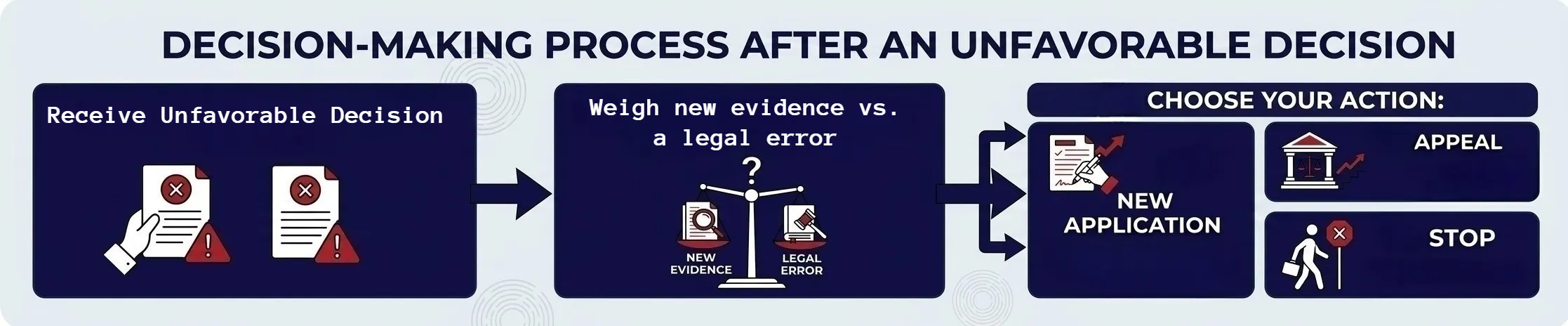
Option 1: Filing a New Disability Application
For most claimants, filing a new application is the stronger path forward, particularly when there's updated medical evidence or a condition that has changed or worsened since the hearing. A new application can be filed as soon as the unfavorable decision arrives. There's no need to wait for an appeal deadline to pass, and no requirement to appeal first.
The Alleged Onset Date (AOD) Rule
A new application's Alleged Onset Date (AOD) can be no earlier than the day after the judge's denial. For example, if the unfavorable decision is dated March 1, 2026, the new AOD must be on or after March 2, 2026.
Why Date Last Insured (DLI) Matters for SSDI
For SSDI specifically, the reader's Date Last Insured (DLI) must fall after the date of the hearing denial. If it doesn't, SSDI eligibility may no longer apply, since DLI is set by recent work credits and doesn't move forward on its own. SSI has no DLI requirement, so this rule affects SSDI applicants only. Quikaid's guide on how work credits affect your SSDI eligibility explains how DLI is calculated and why it matters here.
Option 2: Appealing to the Appeals Council
How to File
The AC iAppeal Online portal is SSA's preferred method for requesting Appeals Council review today. The paper Form HA-520 (Request for Review of Hearing Decision/Order) is still accepted by mail for claimants who prefer it or can't access the online system.
The Deadline
A request for Appeals Council review is generally due within 60 days of receiving the decision, and SSA presumes the decision was received 5 days after the date it was mailed. This is a real deadline with real urgency, but it's not absolute. SSA can accept a late request when a claimant shows good cause, such as a serious illness, hospitalization, or never receiving the decision in the first place.
What the Appeals Council Actually Does
The Appeals Council reviews the judge's decision for legal or factual errors. It has three possible outcomes:
- Deny review. The Appeals Council agrees with the judge's decision and takes no further action.
- Remand. The case goes back to a judge for a new decision, often because of a specific error the Appeals Council identified.
- Grant review and decide the case. The Appeals Council decides the case itself. This is rare.
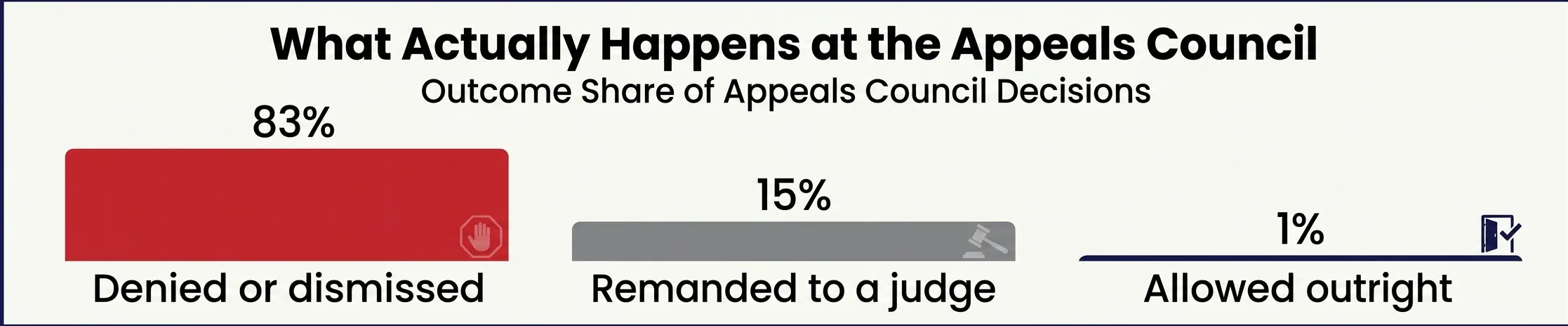
According to SSA's own Appeals Council workload data, the Appeals Council allowed roughly 1% of the disability decisions it reviewed in FY 2025, remanded about 15% back to a judge, and denied or dismissed the rest. This is why, in many cases, a new application with updated evidence can be a faster path than waiting on an appeal.
What New Evidence Counts
The Appeals Council will only consider evidence dated on or before the date of the hearing decision, with narrow exceptions. Evidence about how a condition has changed since the hearing belongs in a new application, not an appeal.
The Timeline
This process commonly takes 1 to 2 years to resolve. That's a real and important factor in deciding whether to appeal or start over with a new application.
Option 3: Appealing to Federal District Court
If the Appeals Council denies review, or a claimant disagrees with the Appeals Council's own decision, the next and final step is filing a civil action in federal district court.
This is a formal legal proceeding, and it generally requires representation. It's also worth setting expectations clearly: the most common favorable outcome at this stage is a remand, meaning the case goes back to SSA for a new hearing, rather than the court awarding benefits outright.
This is the last step in the appeals process, and it's most often considered only after an Appeals Council denial.
Choosing Not to Pursue Your Claim Further
Some claimants decide not to continue after an unfavorable decision, whether because they've returned to substantial gainful activity (SGA), their condition has improved, or it's simply the right decision for them at this time.
No formal notice to SSA is required to stop pursuing a claim. There's no form to file and no one to call if that's the decision that fits.
Rules to Know Before You Decide
A few rules apply no matter which option looks right, and they're easy to miss.
| Rule | What it means | Why it matters |
|---|---|---|
| Can't file new + appeal at once | A new application can't be filed while an Appeals Council request is pending | Avoids a claim conflict; withdraw the appeal first if you want to switch paths |
| New Alleged Onset Date (AOD) | Must be the day after the judge's denial date | Sets the earliest date a new claim can cover |
| Date Last Insured (DLI) for SSDI | Must fall after the denial date | If it doesn't, SSDI eligibility may no longer apply (SSI is unaffected) |
**If a new application is filed while an Appeals Council request is still open, it can create a conflict between the two claims. The straightforward fix is to contact SSA and formally withdraw the pending appeal before submitting the new application.
How Quikaid Can Help After a Hearing Denial
Quikaid is a Social Security disability representation firm, not a law firm, and its team includes both licensed attorneys and SSA-authorized non-attorney representatives who focus exclusively on SSDI and SSI claims. Since 1993, Quikaid has helped over 250,000 people pursue the disability benefits they've earned.
Deciding between a new application and an appeal isn't always straightforward, and getting it wrong can cost months or years. Quikaid's team reviews the judge's decision, looks for errors that might support an appeal, and helps identify what new evidence would strengthen a new application, then tells you whether we believe a new application, an appeal, or another path makes the most sense for your situation.
People who work with an experienced representative are statistically 3 times more likely to be approved for disability benefits than those who go through the process alone.
No upfront cost. Pay only if you win. Fees are capped by federal law.
There's no retainer and no hourly billing, and Quikaid can start reviewing your decision right away.
Quikaid Can Help With SSDI Denial
Get a free disability case review. Quikaid is America's Disability Experts® — no fee unless you win.
Get a Free Case Evaluation Sign Our Contract OnlineThe Bottom Line
A denial at your disability hearing means a choice, not a dead end: file a new application, appeal to the Appeals Council, or stop here. For most claimants with new or stronger evidence, a new application is the faster path, since the Appeals Council allows only about 1 in 100 of the cases it reviews. Whichever path fits, acting quickly protects your options.
If you've been denied after your disability hearing, don't wait to figure out what's next. It's free, there's no obligation, and it only takes about a minute to get started.
Frequently Asked Questions (FAQs)
What should I do if I'm denied at my disability hearing?
Start by reading the judge's written decision carefully to understand why the claim was denied. From there, most claimants either file a new application with updated evidence or appeal the decision to the Appeals Council, depending on the situation.
Is it better to appeal or file a new disability claim after a hearing denial?
It depends on the reason for the denial. If there's new or stronger medical evidence, a new application is often the faster path, since SSA's own data shows the Appeals Council allows only about 1% of the cases it reviews. If the judge made a clear legal or procedural error, an appeal may be worth pursuing.
How long do I have to appeal a disability hearing denial?
You generally have 60 days from receiving the decision to request Appeals Council review, plus SSA's standard mailing grace period. It's never treated as an absolute deadline. SSA can accept a late request for good cause, but acting quickly is always the safer choice.
What happens if I miss the 60-day appeal deadline?
SSA may still accept a late appeal if there's good cause, such as a serious illness or never receiving the decision. Beyond that window, filing a new application instead is usually the more reliable option.
Can I file a new application while my appeal is still pending?
Generally, no. You either need to wait for the Appeals Council to decide, or contact SSA to withdraw the pending appeal before filing a new application.
What does the Appeals Council actually do?
It reviews the judge's decision for legal or factual errors. It can deny review, send the case back to a judge for a new decision, or, rarely, decide the case itself.
Can a disability representative help after a hearing denial?
Yes. An experienced disability representative can review the judge's decision, explain the real options, and help build a stronger case whether the next step is a new application or an appeal.
This article has been reviewed and approved by Quikaid staff, many of whom previously worked at the Social Security Administration in leadership positions within the disability adjudication process.

External Sources Cited in This Guide:
- SSA, Appeals Council review and Form HA-520
- SSA, public workload data files (Appeals Council disposition rates, FY 2025)
- SSA, Disability overview
- NCOA, Who Is Eligible for SSDI?
- USA.gov, Social Security disability benefits overview
Share via:
HIRE AMERICA'S DISABILITY EXPERTS NOW
If you need disability benefits, hire Quikaid now. You will not regret it. We will do everything possible to get your claim approved.
Sign our contract now online, complete our Free Case Evaluation, or call (800) 941-1321 so we can start the process of getting you approved for benefits! You have nothing to lose, and everything to gain.
The time to get started is NOW!