




What Happens Following My Disability Hearing?

Disability Hearing Process
What Happens After Your Disability Hearing? Your Decision Timeline Explained
What happens after your disability hearing? Your case stays with the judge who heard it while a written decision is prepared, and for most claimants, that wait is measured in weeks, not months. There's no fixed legal deadline for a Social Security disability hearing decision, but this guide walks through what happens during that wait, how to check your status, what each type of decision means, and what to do next once your decision arrives.
Key Takeaways (UPDATED: August 24, 2026)
- After your hearing, your case stays with the Administrative Law Judge (ALJ) while a written Notice of Decision is prepared. There's no fixed legal deadline, but many claimants hear back in roughly 6 to 8 weeks.
- A decision is fully favorable, partially favorable, or unfavorable. A bench decision, given out loud at the hearing itself, is uncommon.
- You can track your own case now. A my Social Security account includes a Claim Status Tracker that shows updates, including when a hearing decision is issued.
- If your case stays open after the hearing, it usually means the judge is waiting on something, like medical records or a consultative exam, not a sign that anything went wrong.
- An unfavorable decision isn't the end of the road. You have appeal rights, and depending on your situation, a new application can sometimes be the faster path forward.
What Happens Right After Your Disability Hearing
Once your hearing ends, your case doesn't go anywhere. It stays with the Office of Hearings Operations (OHO), the Social Security Administration (SSA) office that manages disability hearings nationwide. If a source you're reading calls this office ODAR, it's out of date. SSA renamed it OHO back in 2016.
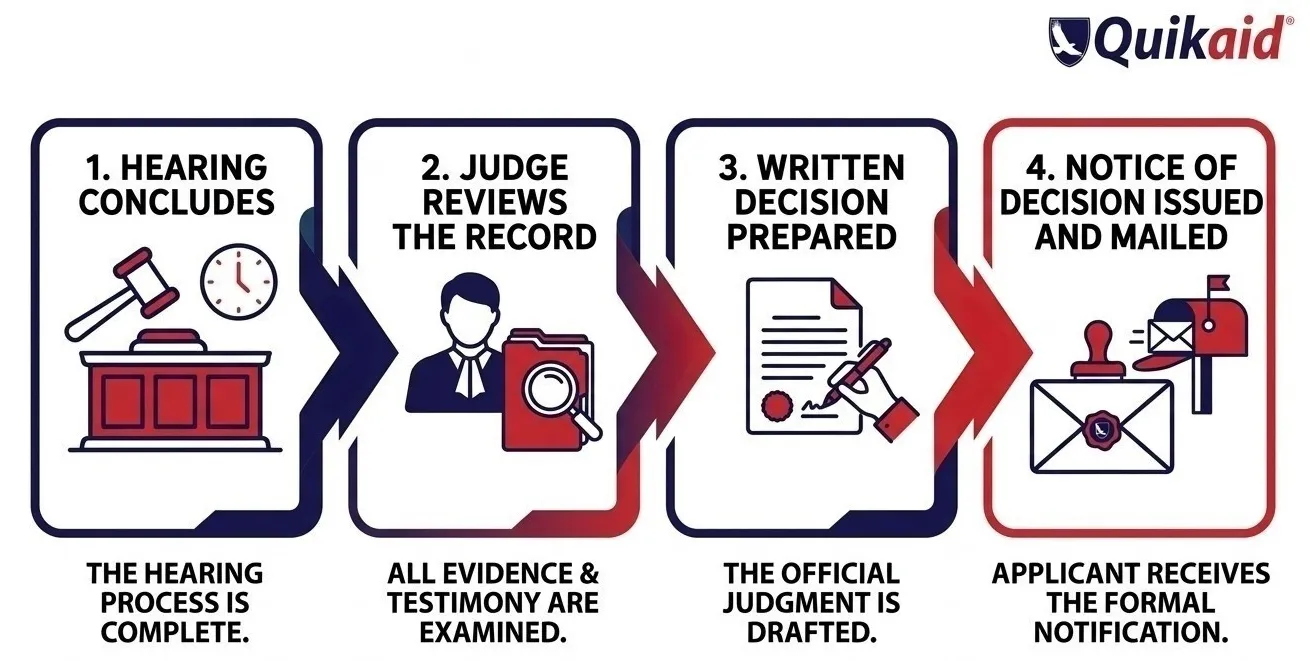
The Administrative Law Judge (ALJ) who heard your case reviews everything in your file, including your testimony and your medical records, and prepares a decision. Staff at the hearing office draft the formal document, called the Notice of Decision, and the judge reviews it before it's issued.
You may have heard that only a representative can check on a case through Electronic Records Express (ERE). That's true of ERE specifically. It's a case-file and status system built for representatives, not the public. But it's no longer the only way to get an update, and it's not even the most useful one for most claimants. The next section covers what changed.
Here's the short version of what happens between your hearing and your decision:
How Long Does It Take to Get a Decision After a Disability Hearing?
There's no statutory deadline for issuing a hearing decision. That's an honest answer, not a satisfying one, so here's what it looks like in practice: many claimants report getting a decision in roughly 6 to 8 weeks after their hearing. A straightforward case with a complete medical record can move faster. A case where the judge needs more information can take several months.
6 to 8 weeks typical range many claimants report between a disability hearing and a written decision
It's worth keeping this number separate from a different one you may see elsewhere: the wait to get a hearing scheduled in the first place. That's a longer, earlier stage of the process, and Quikaid's guide on disability claim timelines by stage covers it in full. This article is only about the wait after your hearing has already happened.
For context, SSA's own published measure of the full hearing stage, from filing a hearing request to a decision, dropped from 285 days in July 2025 to 275 days in July 2026, according to SSA's own performance data. That number reflects the whole hearing stage, not the shorter window after your hearing specifically, but it does show SSA has been working to move hearing-level decisions faster overall.
What Slows a Decision Down
A decision can take longer when the judge needs something that isn't in the file yet. The most common reasons are outstanding medical records, a consultative exam the judge orders after the hearing to get more current medical information, or a case involving multiple conditions that takes more time to review. When this happens, the judge keeps the record open until the missing piece comes in. That's a normal part of the process, not a signal that your case has a problem.
What Can Speed a Decision Up
A complete medical file and a clear written brief already in the record before your hearing give the judge what's needed to decide without having to follow up. That's the real value of solid preparation: it removes the reasons a decision would need to wait. It doesn't change what the judge ultimately decides, and it doesn't promise a faster or more favorable outcome. It just clears the way for a decision to move once the judge is ready to make one.
How to Check the Status of Your Disability Hearing Decision
This is where the process has genuinely changed. As of an SSA announcement dated July 21, 2026, claimants can now track their own case directly, not just through a representative, using the Claim Status Tracker inside their my Social Security account. The tracker shows status updates, including when a hearing decision is issued, along with processing milestones along the way.
Your my Social Security account can also show your filing date, your case's current location, and, before your hearing happens, your scheduled hearing date and time.
If you'd rather not use the online account, or you run into trouble accessing it, you can call SSA directly:
Online: My Social Security account, Claim Status Tracker
Phone: 1-800-772-1213 (TTY 1-800-325-0778), Monday through Friday, 8 a.m. to 7 p.m.
What the Decision Types Mean
Your Notice of Decision will land in one of three categories.
| Decision type | What it means | Does back pay change? |
|---|---|---|
| Fully favorable | The judge agrees you're disabled as of the date and period you claimed | No change |
| Partially favorable | The judge agrees you're disabled, but as of a later date or for a shorter period than you claimed | Yes, back pay reflects the later date |
| Unfavorable | The judge doesn't find you disabled under SSA's rules as they apply to your situation | Not applicable; appeal rights apply |
A partially favorable decision is still an approval. It just means the judge decided your disability began later than you stated, which can reduce the amount of back pay you receive without changing the fact that your case was approved.
Bench Decisions
A bench decision is a fully favorable decision the judge announces out loud, right at the end of the hearing, before the written Notice of Decision is prepared. It's uncommon. Most claimants, even in strong cases, still wait for the written decision. And even after a bench decision, SSA still has to issue the formal written notice before payments can start, so it speeds up the news, not the process that follows it.
What If My Decision Is Unfavorable?
An unfavorable decision isn't the end of your options. You have the right to appeal to the Appeals Council, generally within 60 days of the date on your notice. SSA builds in a short mailing grace period, but it's best to treat 60 days as a real deadline rather than count on that cushion.
One thing worth knowing before you decide how to move forward: the Appeals Council denies the large majority of the appeals it reviews. Depending on your situation, filing a new application can sometimes be the faster path forward, in some cases even while an appeal is still pending. There's no single right answer for every case, which is exactly the kind of decision worth talking through with a representative who can look at your specific situation.
Our guide on what to do if you're denied at your disability hearing walks through your options in full, including how the appeals process works and how to decide between an appeal and a new application.
How Quikaid Can Help After Your Hearing
Since 1993, Quikaid has helped over 250,000 people pursue the Social Security disability benefits they've earned. Quikaid is a Social Security disability representation firm, not a law firm, and its team includes both licensed attorneys and SSA-authorized non-attorney representatives who focus exclusively on SSDI and SSI claims.
While your decision is pending, Quikaid's team can monitor your case, follow up on any outstanding evidence the judge requested, and help you understand your decision and your next steps as soon as it arrives, whether that means your benefits are starting or you're deciding how to respond to an unfavorable decision.
You're 3x more likely to be approved for disability benefits with an expert representative in your corner.
Struggling to get approved for SSDI?
Quikaid is America's Disability Experts®. We handle your entire claim — and you pay nothing unless you win.
Get a Free Case Evaluation Sign Our Contract OnlineNo upfront cost. Pay only if you win. Fees are capped by federal law.
There's no retainer and no hourly billing, and Quikaid can talk through your situation right away.
Frequently Asked Questions (FAQs)
How long does it take to get a decision after a Social Security disability hearing?
There's no fixed legal deadline. Many claimants hear back in roughly 6 to 8 weeks, though it can be faster or take several months if the judge needs more medical evidence.
What is a bench decision?
A bench decision is a fully favorable decision the judge announces out loud at the end of the hearing, before the written notice arrives. It's uncommon, and a written decision still has to be issued before payments start.
Can I check the status of my hearing decision online?
Yes. A my Social Security account includes a Claim Status Tracker that shows updates, including when a hearing decision is issued. You can also call 1-800-772-1213.
What's the difference between a fully favorable and a partially favorable decision?
A fully favorable decision approves your case as of the date you claimed. A partially favorable decision approves it, but as of a later date or for a shorter period, which can affect your back pay.
Why is my case still open after my hearing?
It usually means the judge is waiting on something, often missing medical records or the results of a consultative exam, not a sign that anything went wrong.
What happens if my hearing decision is unfavorable?
You have the right to appeal to the Appeals Council within about 60 days. Depending on your situation, filing a new application can sometimes be the faster path, which is worth discussing with a representative.
Does having a representative change how fast I get a decision?
A representative can't change SSA's timeline. But making sure your medical record and written brief are complete before the hearing is what allows a judge to decide without needing to follow up, which is the biggest factor within anyone's control.
The Bottom Line
After your disability hearing, your case stays open while a written decision is prepared. Most claimants hear back within weeks, not months, and you can now track that wait yourself through a my Social Security account. Once your decision arrives, whether it's fully favorable, partially favorable, or unfavorable, you don't have to sort out what comes next on your own.
It's free, there's no obligation, and it only takes about a minute to get started.
All SSDI and SSI claims are subject to Social Security Administration review and approval. Past results do not guarantee future outcomes. Quikaid's fee is regulated by the SSA and only applies if your claim is approved. The free case evaluation is provided at no obligation.
This article has been reviewed and approved by Quikaid staff, many of whom previously worked at the Social Security Administration in leadership positions within the disability adjudication process.

Share via:
HIRE AMERICA'S DISABILITY EXPERTS NOW
If you need disability benefits, hire Quikaid now. You will not regret it. We will do everything possible to get your claim approved.
Sign our contract now online, complete our Free Case Evaluation, or call (800) 941-1321 so we can start the process of getting you approved for benefits! You have nothing to lose, and everything to gain.
The time to get started is NOW!