




California Disability Attorney or SSDI Expert: How to Choose
California Disability Attorney or SSDI Specialist
California has a short-term state disability program, but it only covers temporary absences. For a condition expected to last a year or longer, most people apply for two federal programs: Social Security Disability Insurance (SSDI) and Supplemental Security Income (SSI). Both are run by the Social Security Administration (SSA). Your medical condition must keep you from working full time for at least 12 months. SSDI also depends on your work history, and SSI depends on your income and assets. In California, a state agency called the Disability Determination Service Division (DDSD) makes the first medical decision.
At a Glance: Disability Benefits in California
- Programs: SSDI and SSI (federal). California also has State Disability Insurance (SDI) for short-term absences.
- Who gets benefits: 2.1% of California adults ages 18 to 64, tied for 48th among the 50 states (U.S.: 3.5%)
- First decision: about 191 days on average nationally (fiscal year 2026)
- Hearing offices: 17 across the state
- 2027 SSI federal maximum: $1,029 a month for one person ($994 in 2026); California adds a state supplement
- How to start: online at SSA.gov, by phone at 1-800-772-1213, at a California Social Security office, or with a representative like Quikaid
Sources: SSA Annual Statistical Report on the SSDI Program, 2025; SSA FY 2026 Year in Review; SSA 2027 COLA Fact Sheet
Key Takeaways (Published: November 5, 2026)
- Social Security disability is the main long-term option in California. State Disability Insurance (SDI) is for short absences only.
- About 1 in 48 California adults ages 18 to 64 (2.1%) receives Social Security disability benefits, below the national rate.
- SSA doesn't decide based on a diagnosis alone. It weighs your medical evidence, age, education, past work, and ability to work full time.
- California's DDSD approved 39.0% of first applications in fiscal year 2024, above the national rate of 38.3%. Many approvals come later, on appeal.
- In 2027, federal SSI pays up to $1,029 a month for one person, and California adds a state supplement. SSDI amounts depend on your past earnings, and the national average for disabled workers is about $1,701 a month.
- A representative can charge 25% of your back pay or $9,200, whichever is less. You pay nothing upfront, and nothing at all if you don't win.
- Quikaid - America's Disability Experts® has helped over 250,000 people since 1993, and we help California residents from start to finish. Call (800) 941-1321.
Does California Have a State Disability Program?
Yes, but only for short-term absences. California is one of only a handful of states with its own short-term disability program. State Disability Insurance (SDI), run by the Employment Development Department (EDD), replaces part of your wages for up to 52 weeks if a non-work illness or injury keeps you off the job. It's funded by deductions from your paycheck. SDI is short-term help. If you expect to be out of work for 12 months or longer, you can apply for SDI and Social Security disability at the same time.
For long-term disability, the federal programs run by the Social Security Administration (SSA) are the main source of benefits. The two programs use the same medical rules but have different money rules.
| SSDI | SSI | |
|---|---|---|
| Who it's for | People who worked and paid Social Security taxes | People with limited income and assets, including those with little or no work history |
| What decides eligibility | Your work credits | Your income, assets, and living situation |
| How the payment is set | Based on your past earnings | Federal maximum plus the California supplement, minus countable income |
| Waiting period | Five full months after your disability starts | None |
| Health coverage | Medicare after 24 months of SSDI | Medi-Cal, usually right away |
| Can children qualify? | On a parent's record | Yes, based on household income |
You may qualify for both at the same time. This is called concurrent benefits. Learn more about the differences between SSDI and SSI.
Other options in California
- CalFresh. People who get SSI in California can also apply for CalFresh food benefits.
- Private disability insurance. If you have a short-term or long-term policy through work, file a claim with the insurer. It follows its own rules.
- Veterans disability benefits. You can receive benefits from the Department of Veterans Affairs (VA) and SSA at the same time. A VA rating doesn't guarantee approval by SSA, because the two programs use different rules.
- Workers' compensation. You can receive workers' comp and SSDI together, but SSA may reduce your SSDI to account for it.
Social Security doesn't pay for short absences. You apply for SSDI or SSI when you expect to be unable to work for 12 months or longer.
Why this matters to you: Even if you have state, private, or VA coverage, applying for SSDI or SSI early can protect your back pay.
Disability in California by the Numbers
In December 2025, the Social Security Administration (SSA) reported that 2.1% of California residents ages 18 to 64 received disability benefits, below the national rate of 3.5%. Because California is so large, that still adds up to 487,142 disabled workers on SSDI, more than in any other state.
Bar chart: share of adults 18 to 64 receiving Social Security disability benefits, December 2025. Oregon 3.6%, United States 3.5%, Arizona 2.9%, Washington 2.8%, Nevada 2.7%, California 2.1%.
| California, December 2025 | Number |
|---|---|
| Disabled workers receiving SSDI | 487,142 |
| People receiving SSI | 1,106,560 |
| SSI recipients who qualify through disability or blindness | 760,326 |
| Children under 18 receiving SSI | 86,167 |
| SSI recipients who also get Social Security | 467,293 |
| Average SSI payment in California | about $869 a month |
| County with the most SSI recipients | Los Angeles County (341,256) |
Sources: SSA, Annual Statistical Report on the SSDI Program, 2025; SSA, SSI Recipients by State and County, 2025. The SSI average is calculated from SSA's reported total monthly payments, which include the federally paid part of the state supplement.
Why this matters to you: If you're applying in California, you're far from alone. Hundreds of thousands of your neighbors have been through this same process.
How to Qualify for Disability in California
To qualify, you must meet the Social Security Administration's (SSA) medical rules and one program's money rules. The medical rules are the same for SSDI and SSI, and they're the same in every state. Your condition, or a combination of conditions, must keep you from working full time for at least 12 months or be expected to end in death.
SSA doesn't decide based on which diagnosis you have. It looks at how severe your symptoms are and how strong your medical evidence is. It weighs several factors together, including your age, education, and past work.
The Social Security Administration evaluates disability claims using a five-step process, answering these basic questions:
- Are you working full time?
- Is your condition severe?
- Does your condition meet a listing?
- Can you do your past work?
- Can you do any other work?
In the majority of disability claims, the last question is the one that matters most, and this is where a well-built case can make the difference between an approval and denial.
For step three, SSA uses its Listing of Impairments, often called the Blue Book. For steps four and five, SSA looks at the jobs you've held in the past five years and what you can still do, which it calls your residual functional capacity (RFC). If you're 50 or older, SSA's rules recognize that it's harder to switch to a new kind of work, and that can help.
SSDI work requirements
SSDI is insurance you paid for through payroll taxes. You earn up to four work credits a year. Most adults need 40 credits, with 20 earned in the 10 years before their disability began. That's about five of the last 10 years. Younger workers need fewer credits. See how work credits affect SSDI eligibility.
SSI income and asset limits
SSI is based on need. Your countable resources, such as cash and bank accounts, must be $2,000 or less for one person or $3,000 or less for a couple. Your home and usually one car don't count. Your countable income must be below the SSI payment limit, after SSA ignores some income.
2026 and 2027 limits at a glance
| Limit | 2026 | 2027 |
|---|---|---|
| SSI federal maximum, individual | $994 a month | $1,029 a month |
| SSI federal maximum, couple | $1,491 a month | $1,544 a month |
| SSI resource limit, individual / couple | $2,000 / $3,000 | $2,000 / $3,000 |
| Substantial gainful activity (SGA), most people | $1,690 a month | $1,770 a month |
| SGA, blind | $2,830 a month | $2,950 a month |
| Earnings for one work credit | $1,890 | $1,970 |
Source: SSA 2027 COLA Fact Sheet. 2027 amounts take effect in January 2027 (SSI payments dated December 31, 2026).
Substantial gainful activity (SGA) is SSA's measure of working full time. If your gross earnings are above the SGA amount, SSA will usually find you aren't disabled. Learn more about how work affects your benefits.
Why this matters to you: Many people rule themselves out before anyone at SSA looks at their application. Plenty of people who assumed they'd never qualify end up getting approved.
Conditions That Qualify for Disability in California
Any physical or mental condition can qualify if it keeps you from working full time for at least 12 months. The Social Security Administration (SSA) looks at all of your conditions together, along with your symptoms and medication side effects. Conditions that seem minor on their own can add up.
Common categories include:
- Musculoskeletal conditions, such as back disorders, arthritis, and joint problems. These are the most common reason people receive SSDI nationwide.
- Mental health conditions, such as depression, bipolar disorder, anxiety, and schizophrenia
- Nervous system disorders, such as epilepsy, multiple sclerosis, and neuropathy
- Heart and circulatory conditions, such as heart failure
- Cancer, kidney disease, and lung conditions, such as COPD
Some severe conditions qualify for a faster decision through SSA's Compassionate Allowances program, which covers more than 300 conditions and is regularly expanded.
Why this matters to you: List every condition when you apply, even ones you think don't matter. SSA looks at the whole picture.
How to Apply for Disability in California
You can apply for SSDI or SSI with the Social Security Administration (SSA) in three ways:
- Online at SSA.gov. This works best for SSDI.
- By phone at 1-800-772-1213, Monday through Friday, 8 a.m. to 7 p.m. local time.
- In person at a Social Security office in California. Call first to book an appointment. Find your nearest office with the SSA office locator.
When you work with Quikaid, we gather your information and submit your application. We follow up with SSA on anything it needs and stay with you until there's a decision.
Leverage The Expertise of America's Disability Experts®
Whether you're applying, appealing, or waiting on payment after approval, Quikaid will do everything possible to get you paid. Free case evaluations, and no fee unless you win.
Get Started Online Now Call (800) 941-1321What to have ready
You need less than you might think to get started:
- Names, addresses, and visit dates for your doctors, hospitals, and clinics
- A list of your current medications
- Your jobs from the past five years, including what you lifted and how long you stood or sat
- Your Social Security number and a bank account for direct deposit
You don't need to collect your medical records before you apply. SSA requests them directly from your providers. See our disability application checklist.
What happens after you apply in California
| Step | Who handles it | What happens |
|---|---|---|
| 1. Application | Your local SSA field office | Checks your work credits (SSDI) or income and assets (SSI) |
| 2. Medical review | California Disability Determination Service Division (DDSD), part of the California Department of Social Services (CDSS) | Requests your medical records and decides if you meet SSA's definition of disability |
| 3. Consultative exam (if needed) | A doctor the DDSD pays for | A short exam if your records don't give enough information |
| 4. Decision | SSA | You receive a letter approving or denying benefits |
If the DDSD sends you a form or schedules an exam, respond right away. Missed forms and exams are a common reason for delays and denials. Learn more about the medical evidence that supports a disability claim.
Why this matters to you: Make sure SSA and your representative can always reach you. If they can't, your application could be denied.
Ready to see if we can help? See If You Qualify or call (800) 941-1321.
How Long Does It Take to Get Disability in California?
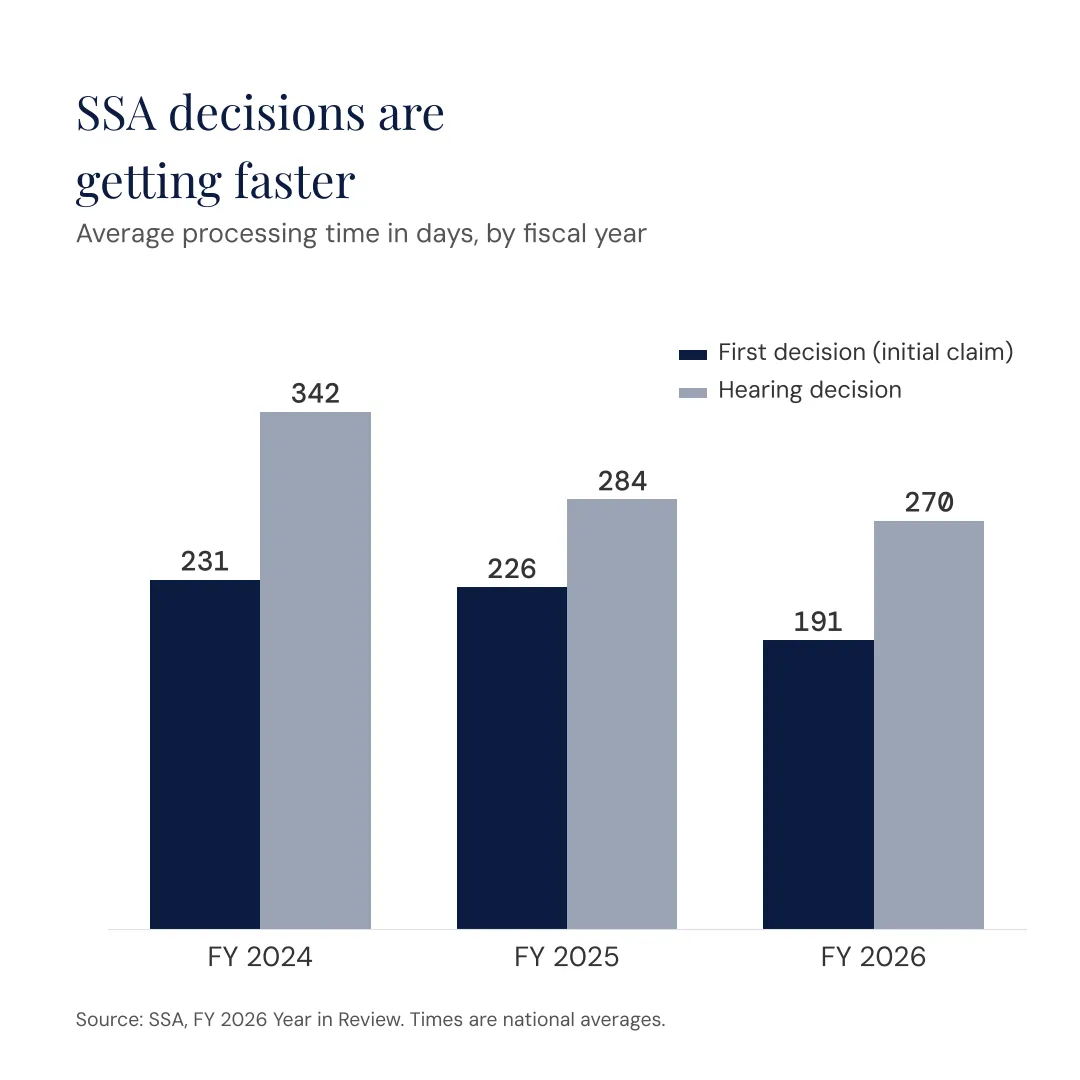
Most California applicants wait about six months for a first decision. Nationally, the Social Security Administration (SSA) took 191 days on average to decide initial disability claims in fiscal year 2026, down from 231 days in 2024. If you appeal to a hearing, the full process can take a year or more.
| Stage | Typical timing |
|---|---|
| Initial application | About 191 days (national average, FY 2026) |
| Reconsideration | Several more months [VERIFY: current SSA average] |
| Wait for a hearing in California | About 8 to 10 months after you request it (August 2026) |
| Hearing decision | About 270 days on average from request to decision (national, FY 2026) |
Sources: SSA, FY 2026 Year in Review; SSA hearing office data, August 2026.
The whole process can take anywhere from about 30 days to more than two years. It depends on your age, past work, education, and most of all, the strength of your medical evidence. See how long a disability decision takes.
California's approval rates
In fiscal year 2024, California's DDSD approved 39.0% of initial applications, compared with 38.3% nationally. At reconsideration, California approved 19.6%, above the national rate of 15.9%.
| Stage | California (FY 2024) | United States (FY 2024) |
|---|---|---|
| Initial application | 39.0% | 38.3% |
| Reconsideration | 19.6% | 15.9% |
Source: SSA State Agency Operations Report, FY 2024.
Receiving a denial is unfortunately part of the process for most claimants. However, you have the right to appeal. This is one step where it can be extremely helpful to have an experienced representative in your corner.
The appeal steps in California
You have 60 days from the date you receive a denial to appeal. SSA allows five extra days for mail and can accept a late appeal if you have a good reason.
- Reconsideration. A new examiner reviews your file.
- Hearing before an Administrative Law Judge (ALJ). This is where many claims are won. You're 3x more likely to be approved for disability benefits at a hearing with an expert representative in your corner.
- Appeals Council review.
- Federal court.
Until 2019, parts of Los Angeles were "prototype" areas that skipped reconsideration and sent appeals straight to a hearing. SSA restored the reconsideration step on January 1, 2019 in the Los Angeles North and West branches, so California now follows the same four steps as every other state. Older guides that say otherwise are out of date. Read more about the disability appeal process.
California's hearing offices
Your hearing is usually held at the office that serves the area where you live.
| Hearing office | Average wait until hearing (August 2026) |
|---|---|
| Long Beach | 8.0 months |
| Moreno Valley | 8.0 months |
| Norwalk | 8.0 months |
| Oakland | 8.0 months |
| Orange | 8.0 months |
| Sacramento | 8.0 months |
| San Bernardino | 8.0 months |
| San Francisco | 8.0 months |
| Santa Barbara | 8.0 months |
| Stockton | 8.0 months |
| Los Angeles (West) | 8.5 months |
| Pasadena | 8.5 months |
| Fresno | 9.0 months |
| Los Angeles (Downtown) | 9.0 months |
| San Diego | 9.0 months |
| San Jose | 9.0 months |
| San Rafael | 10.0 months |
Source: SSA hearing office data, August 2026.
Why this matters to you: Hearing waits are shorter than they were a few years ago. Do not wait until the last day to appeal. Every day counts.
How Much Is Disability in California?
Your monthly payment depends on which program you qualify for. SSDI is based on your lifetime earnings. SSI is based on the federal maximum, plus any California supplement, minus your countable income. The Social Security Administration (SSA) calculates both, and amounts rise each year with the cost-of-living adjustment (COLA).
| 2026 | 2027 | |
|---|---|---|
| Average SSDI, disabled worker (national) | $1,642 a month | $1,701 a month |
| Average SSDI, disabled worker with spouse and child (national) | $2,970 a month | $3,077 a month |
| Highest possible Social Security benefit at full retirement age | $4,152 a month | $4,188 a month |
| SSI federal maximum, individual | $994 a month | $1,029 a month |
| SSI plus California supplement, individual (maximum) | $1,233.94 a month | [2027 amount pending] |
| Average SSI payment in California | about $869 a month (December 2025) | n/a |
Sources: SSA 2027 COLA Fact Sheet (January 2027 estimates before and after the 3.6% COLA); SSA SSI state data, December 2025.
To see your own SSDI estimate, sign in to my Social Security. Your statement shows what you'd receive if you became disabled today. Learn more about how SSA calculates your disability benefit.
Does California add money to SSI?
Yes. California adds one of the largest state supplements in the country, called the State Supplementary Payment (SSP). It's added automatically to your federal SSI, and you get one combined payment. The amount depends on your living situation.
| 2026 living situation | Federal SSI | California supplement | Combined maximum |
|---|---|---|---|
| Individual, own household | $994.00 | $239.94 | $1,233.94 |
| Couple, own household | $1,491.00 | $607.83 | $2,098.83 |
| Individual without cooking facilities | $994.00 | $368.81 | $1,362.81 |
| Individual in another person's household | $662.67 | $245.20 | $907.87 |
Source: California DHCS, SSI/SSP Payment Standards Effective January 1, 2026. The federal part rises in January 2027.
Health coverage
- SSI: In California, people approved for SSI automatically qualify for Medi-Cal. SSA's SSI approval counts as your Medi-Cal application.
- SSDI: You become eligible for Medicare after 24 months of SSDI benefits.
Back pay and taxes
If you're approved, you may receive back pay for the months you waited. For SSDI, back pay can reach as far back as 12 months before your application date, after a five-month waiting period. That's one reason not to put off applying.
California doesn't tax Social Security benefits, so your SSDI isn't subject to California income tax. Your SSDI may be subject to federal income tax only if your total household income is high enough.
Why this matters to you: Most people who are approved receive several months, sometimes years, of back pay, plus monthly benefits and Medicare or Medi-Cal.
Getting Help With Disability in California
You can apply on your own, but you don't have to. A disability representative can file your application, track deadlines, gather evidence, and represent you at your hearing. Both attorneys and non-attorney representatives authorized by the Social Security Administration (SSA) can represent you before SSA. Learn the difference between a disability lawyer and a disability representative.
Most people don't get help. In a 2026 Quikaid survey of 1,100 U.S. adults who had researched or pursued disability benefits, only 11% had gotten professional help. More than three out of four (77%) had thought about giving up at some point.
Questions to ask any California representative
| Question | Why it matters |
|---|---|
| Is Social Security disability all you do? | Focus means they know SSA's rules, forms, and deadlines |
| Who will actually handle my application and appeal? | You want to know if a team or one busy person is working on it |
| Do you charge for medical records or copies? | Some firms add these costs on top |
| How will you keep me updated? | Long waits are easier when someone answers the phone |
| Do you handle cases in California hearing offices? | You don't need a local office, but experience with the process matters |
How Quikaid helps California residents
Quikaid - America's Disability Experts® is a Social Security disability representation firm. We've focused only on SSDI and SSI since 1993, and we've helped over 250,000 people. We help people in all 50 states, including California, so you never need to visit our office. We stay in touch by phone, text, email, and mail.
Need Help With Your Disability Claim?
Get a free disability case review. Quikaid is America's Disability Experts® — no fee unless you win.
Get a Free Case Evaluation Get Started Online- We file for you. We gather your information and submit your application.
- We handle medical records at the hearing level, and we pay for them ourselves. You never get a bill for them.
- We track every deadline, so a missed form doesn't slow things down.
- We answer the phone, or return your call the same day.
Client Stories: Click Here to View Our Testimonials
It's understandable to worry about the cost, and it's one of the most common reasons people delay getting help. Payment for disability representation doesn't work like it does for other legal services.
No upfront cost. Pay only if you win. Fees are capped by federal law.
Under federal law, a representative can charge 25% of your back pay or $9,200, whichever is less. SSA pays the representative directly from your back pay, and your monthly benefits are never touched. We don't require a retainer. There's no hourly billing, and we can provide you with guidance now.
Frequently Asked Questions (FAQs)
Are the qualifications for disability the same in California as in every other state?
Yes. SSDI and SSI are federal programs, so the medical and work rules are the same in all 50 states. What differs is who handles your application. In California, the Disability Determination Service Division (DDSD) makes the first medical decision, and your hearing is held at one of California's 17 hearing offices.
How long does SSDI take to get approved in California?
Most people wait about six months for a first decision. SSA averaged 191 days nationally in fiscal year 2026. If you're denied and appeal, California's hearing offices averaged 8 to 10 months from request to hearing in August 2026. The full process can range from about 30 days to more than two years.
How much is SSDI per month in California?
SSDI is based on your past earnings, not where you live. Nationally, the average disabled worker receives about $1,642 a month, rising to about $1,701 in January 2027. You can see your own estimate in your my Social Security account.
How much does SSI pay in California, and does California add a state supplement?
In 2027, the federal SSI maximum is $1,029 a month for one person and $1,544 for a couple. California adds a State Supplementary Payment (SSP). In 2026, the combined SSI/SSP maximum is $1,233.94 a month for one person living in their own household. California's average SSI payment was about $869 a month in December 2025.
How does Medicaid eligibility relate to SSI in California?
In California, SSI approval automatically qualifies you for Medi-Cal, so you don't need a separate application. SSDI works differently. If you receive SSDI, you become eligible for Medicare after 24 months of benefits. Some people with low SSDI payments also qualify for Medi-Cal or help paying Medicare costs.
Can I get California SDI and Social Security disability at the same time?
Yes. SDI is a short-term state program that pays for up to 52 weeks. SSDI and SSI are federal programs for conditions expected to last at least 12 months. Many Californians file for both. SDI doesn't reduce your SSDI. If you get SSI, SSA counts SDI payments as income.
Where can I find help applying for SSDI benefits in California?
You can apply directly with SSA or work with a disability representative. Quikaid has helped over 250,000 people since 1993 and helps California residents apply and appeal. There's no upfront cost, and you pay only if you win. Start a Free Case Evaluation or call (800) 941-1321.
California Disability Resources
| Resource | What it helps with | Contact |
|---|---|---|
| Social Security Administration (SSA) | Applications, payments, appointments | 1-800-772-1213, SSA.gov |
| Employment Development Department (EDD) | State Disability Insurance (SDI) | edd.ca.gov |
| Department of Health Care Services (Medi-Cal) | Health coverage | www.dhcs.ca.gov |
| California Department of Social Services | SSP, CalFresh, and In-Home Supportive Services | www.cdss.ca.gov |
| Disability Rights California | California's free protection and advocacy organization | www.disabilityrightsca.org |
Research Sources Used For This Page:
- SSA Annual Statistical Report on the SSDI Program, 2025 (Tables 8 and 9)
- SSA SSI Recipients by State and County, 2025, Table 1 and Table 2
- FY2024 State Allowance Rates (NOSSCR, from SSA data)
- MyBenefitsData: Fastest and Slowest Hearing Offices
- SSA POMS SI 01715.010 (Medicaid categories)
- Federal Register, Dec 12, 2018
- Kiplinger: States That Tax Social Security Benefits in 2026
- Triage Cancer: State Disability Insurance
- California DHCS SSI/SSP Payment Standards, 2026
- SSI by county: California
- State disability agencies: Nolo: California
- SSA FY 2026 Year in Review
Share via:
HIRE AMERICA'S DISABILITY EXPERTS NOW
If you need disability benefits, hire Quikaid now. You will not regret it. We will do everything possible to get your claim approved.
Sign our contract now online, complete our Free Case Evaluation, or call (800) 941-1321 so we can start the process of getting you approved for benefits! You have nothing to lose, and everything to gain.
The time to get started is NOW!